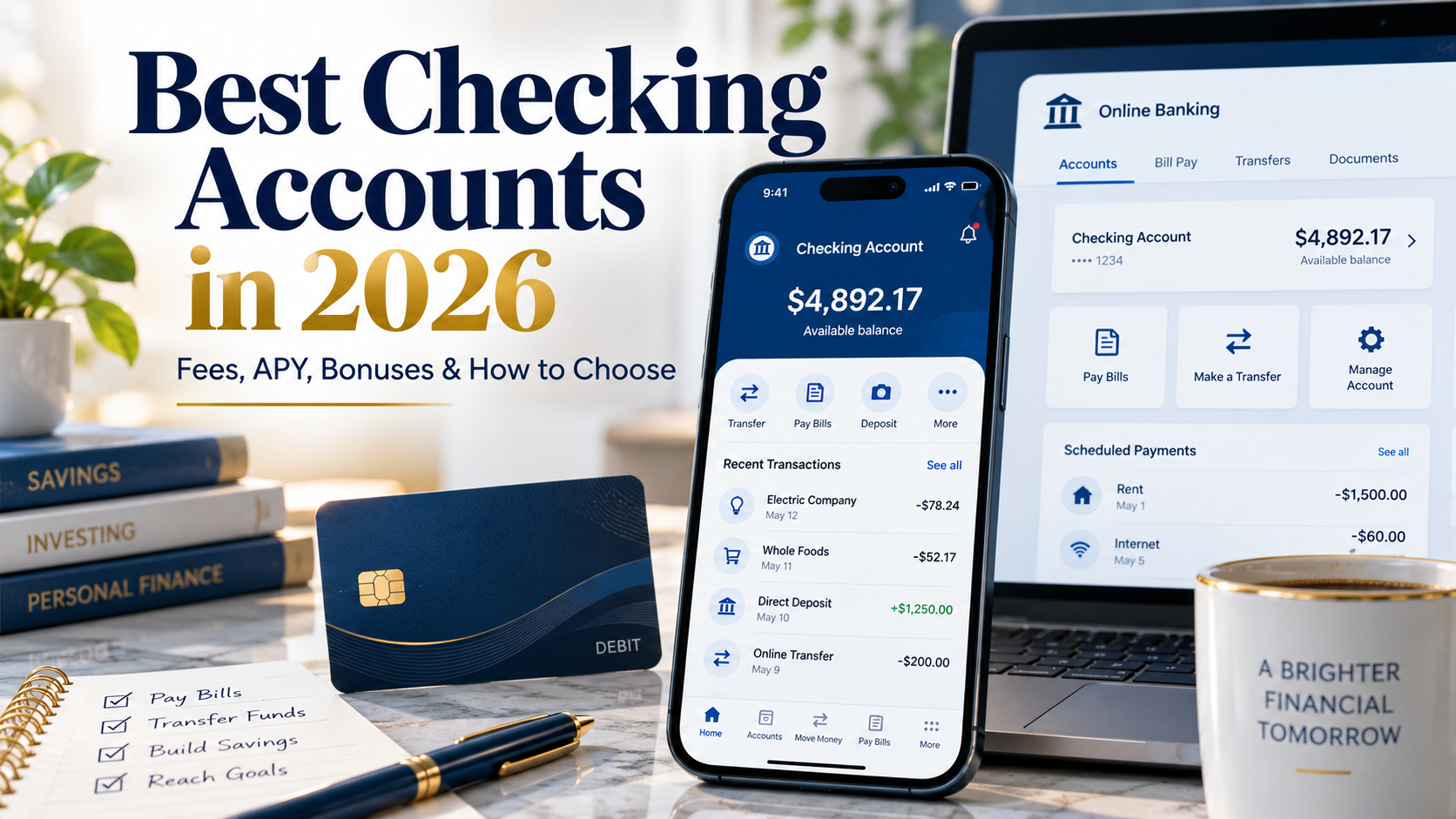
Best Checking Accounts in 2026: Fees, APY, Bonuses & How to Choose
A checking account is where most people receive income, pay bills, use a debit card and manage everyday spending.
But not all checking accounts cost the same.
Some banks charge monthly maintenance fees, overdraft fees and ATM fees. Others offer checking accounts with no monthly fee, no minimum balance and even interest on your balance.
Choosing the right account can therefore save money every month.
This guide explains how to find the best checking accounts in 2026, including account fees, APY, ATM access, overdraft policies, FDIC insurance and features you should compare before opening an account.
What Is a Checking Account?
A checking account is a bank deposit account designed for regular transactions.
You can normally use it to:
• Receive your salary
• Pay bills
• Make debit card purchases
• Withdraw cash
• Send money
• Deposit checks
• Set up automatic payments
• Receive direct deposits
Unlike a savings account, a checking account is designed for frequent spending.
That makes convenience and fees especially important.
What Makes a Good Checking Account?
The best checking accounts usually combine several features:
No monthly maintenance fee
No minimum balance requirement
Large ATM network
Low or no overdraft fees
Strong mobile banking
Direct deposit
Bill pay
Debit card access
FDIC insurance
Some accounts also pay interest.
That is useful, but the APY should not be the only reason you choose a checking account.
Best Checking Accounts to Compare in 2026
Here are examples of major checking accounts with useful features.
| Account | Monthly fee | Minimum opening deposit | Interest |
|---|---|---|---|
| Capital One 360 Checking | $0 | $0 | Yes |
| Ally Spending Account | $0 | $0 | 0.10% to 0.25% APY |
| Traditional bank checking | Varies | Varies | Often low or none |
Rates and account terms can change.
Always verify current details before applying.
Capital One 360 Checking
Capital One 360 Checking is designed as a low-fee online checking account.
Capital One currently states that the account has:
• No monthly service fee
• No minimum balance requirement
• No minimum opening deposit
• No overdraft fees
• Interest on the account balance
• Access to more than 70,000 fee-free ATMs through supported networks (capitalone.com)
Capital One also says it does not charge customers for using out-of-network ATMs, although the ATM operator may charge its own fee. (capitalone.com)
This type of account can work well for people who want:
• Online banking
• No monthly fee
• Debit card access
• Zelle
• Mobile check deposit
• A large ATM network
The account pays interest, although checking APYs are generally much lower than high-yield savings rates.
Ally Spending Account
Ally’s Spending Account is another online checking option.
As of October 1, 2026, Ally lists:
0.10% APY for balances below $15,000
and:
0.25% APY for balances of $15,000 or more. (ally.com)
Ally also currently charges:
• $0 monthly maintenance fee
• $0 overdraft item fee
• $0 low balance fee
• $0 for standard debit cards
• $0 minimum deposit to open (ally.com)
Customers can use Allpoint and MoneyPass ATMs without Ally ATM fees.
Ally also provides up to $10 per statement cycle in reimbursement for certain ATM fees charged by other US ATM operators. (ally.com)
This account can be attractive if you want to combine your checking and savings at one online bank.
Should Your Checking Account Pay Interest?
Interest is useful, but checking accounts are usually not the best place for large cash reserves.
Suppose you keep:
$10,000
in a checking account paying:
0.10% APY
You would earn roughly:
$10 per year
before taxes if the rate remained unchanged.
If a high-yield savings account pays around 3%, the same balance could earn roughly:
$300 per year
before taxes.
That means many people benefit from using:
Checking for spending
and:
High-yield savings for larger cash balances
Keep enough money in checking for bills and normal spending.
Move extra cash into a higher-yield account when appropriate.
Checking Account Fees to Watch
Fees can make an otherwise convenient account expensive.
Monthly Maintenance Fee
Some banks charge a monthly fee unless you meet requirements such as:
• Minimum balance
• Direct deposit
• Relationship balance
• Debit card activity
A $12 monthly fee equals:
$144 per year
That is why no-fee checking accounts can be attractive.
Overdraft Fees
An overdraft happens when you spend more than your available balance.
Some banks still charge overdraft fees.
Others have eliminated or reduced them.
Capital One says its 360 Checking account has no overdraft fees. (capitalone.com)
Ally currently lists a $0 overdraft item fee. (ally.com)
Review the bank’s overdraft policy carefully.
ATM Fees
ATM charges can come from:
• Your bank
• The ATM operator
Some online banks provide large fee-free networks or reimburse some ATM fees.
Wire Transfer Fees
Outgoing wires can cost money.
Ally, for example, currently lists a $20 fee for outgoing domestic wires. (ally.com)
If you send wires regularly, compare fees before opening an account.
Foreign Transaction Fees
Travelers should check whether debit card transactions outside the United States carry extra charges.
Ally currently lists international transaction charges of up to 1% for certain transactions. (ally.com)
Are Checking Accounts FDIC Insured?
Checking accounts at FDIC-insured banks are generally covered by federal deposit insurance.
The standard FDIC insurance amount is:
$250,000 per depositor, per insured bank, per ownership category.
FDIC insurance covers eligible deposit products such as:
• Checking accounts
• Savings accounts
• Money market deposit accounts
• Certificates of deposit
It does not cover investments such as stocks, bonds or mutual funds.
Before opening an unfamiliar online account, verify that the bank is FDIC insured.
What Happens if Your Bank Fails?
If an FDIC-insured bank fails, eligible deposits are protected up to applicable insurance limits.
The FDIC states that checking and other insured deposits receive automatic protection at insured institutions.
You do not normally need to buy deposit insurance separately.
However, deposits held in the same ownership category at the same bank are generally combined when calculating coverage.
If you hold very large cash balances, review FDIC ownership categories carefully.
Online Bank vs. Traditional Bank
Both can be useful.
| Online Bank | Traditional Bank |
|---|---|
| Often lower fees | Physical branches |
| Strong mobile apps | Cash deposits easier |
| Often higher APY | Face-to-face service |
| Large partner ATM networks | Bank-owned ATMs |
| Fewer branches | More local services |
An online checking account may work well if you rarely need branch services.
A traditional bank can make more sense if you frequently deposit cash, use cashier’s checks or prefer in-person assistance.
Checking Account vs. Savings Account
A checking account is designed for spending.
A savings account is designed for storing money.
Checking usually provides:
• Debit card
• Frequent transactions
• Bill pay
• Direct deposits
Savings usually provides:
• Higher APY
• Fewer spending features
• Better environment for emergency savings
Many people should have both.
Checking Account vs. Money Market Account
Money market deposit accounts can sometimes offer:
• Higher interest
• Debit card access
• Checks
However, transaction limits or account rules may be different.
Ally, for example, currently lists its Money Market Account at 3.00% APY as of September 10, 2026, but applies limits to certain withdrawals per statement cycle. (ally.com)
A checking account remains better for everyday transactions.
What Is Early Direct Deposit?
Some banks make qualifying direct deposits available before the official payday.
This can mean receiving salary up to one or two days early depending on when the employer sends payment information.
Early direct deposit can be convenient.
But do not choose a bank solely because of this feature.
The actual timing depends on payroll processing.
Can You Open a Checking Account Online?
Yes.
Many banks allow the entire process online.
You may need:
• Full legal name
• Date of birth
• Home address
• Social Security number or tax information
• Government-issued identification
• Email address
• Phone number
The bank is legally required to verify customer identity.
How to Choose the Best Checking Account
Look for $0 Monthly Fees
Avoid paying for everyday banking when a comparable free account is available.
Check Minimum Balance Requirements
Some accounts waive fees only if you maintain a specific balance.
Review ATM Access
Look at the number of fee-free ATMs near where you live and work.
Check Overdraft Rules
A single overdraft fee can erase months of small interest earnings.
Review Mobile Banking
A strong banking app should allow:
• Mobile deposits
• Transfers
• Card controls
• Account alerts
• Bill payments
Look at Customer Support
Some online banks provide 24-hour support.
Others have more limited hours.
Verify FDIC Insurance
Check the bank itself, not just the financial app or brand.
How Much Money Should You Keep in Checking?
There is no universal amount.
A simple method is to keep enough for:
One month of normal expenses
plus:
A small buffer
Suppose your monthly bills are $4,000.
You might keep around $4,500 to $6,000 in checking, depending on your spending pattern.
Extra emergency savings could be moved to a high-yield savings account.
Joint Checking Accounts
A joint checking account is owned by two or more people.
Couples may use it for:
• Rent
• Mortgage
• Utilities
• Food
• Child expenses
• Shared savings transfers
Before opening a joint account, understand that each joint owner may have broad access to the money.
Checking Accounts for Students
Students should look for accounts with:
• No monthly fees
• No minimum balance
• Large ATM network
• Mobile banking
• Low overdraft risk
A checking account without monthly charges can be especially useful when income is limited.
Mistakes to Avoid
Do not choose an account based only on a signup bonus.
Do not ignore monthly fees.
Do not leave a large emergency fund earning almost no interest.
Do not assume every ATM is free.
Do not ignore overdraft policies.
Do not share online banking passwords.
Do not assume a fintech app is itself an FDIC-insured bank.
Check where your deposits are actually held.
Frequently Asked Questions
What is the best checking account with no monthly fee?
Accounts such as Capital One 360 Checking and Ally Spending currently charge no monthly maintenance fee. (capitalone.com)
Does Capital One 360 Checking require a minimum balance?
No. Capital One currently states there is no minimum balance requirement and no minimum opening deposit. (capitalone.com)
Does Ally checking pay interest?
Yes. Ally’s Spending Account currently pays 0.10% APY below $15,000 and 0.25% APY at $15,000 or more. (ally.com)
Are checking accounts insured?
Eligible checking deposits at FDIC-insured banks are covered up to applicable FDIC limits.
Should I keep all my money in checking?
Usually not.
Checking is useful for spending, while high-yield savings can pay more interest on money you do not need every day.
Final Thoughts
The best checking accounts in 2026 should make everyday banking simple and inexpensive.
Prioritize:
No monthly maintenance fee
No or low minimum balance
Low overdraft costs
Large ATM access
Strong mobile banking
FDIC insurance
Capital One 360 Checking currently combines no monthly fee, no minimum balance and no overdraft fees. Ally’s Spending Account combines no monthly maintenance fee with interest of up to 0.25% APY depending on balance. (capitalone.com)
Do not choose a bank simply because it advertises a bonus.
Choose an account that will still be affordable and useful after the promotion ends.