Introduction
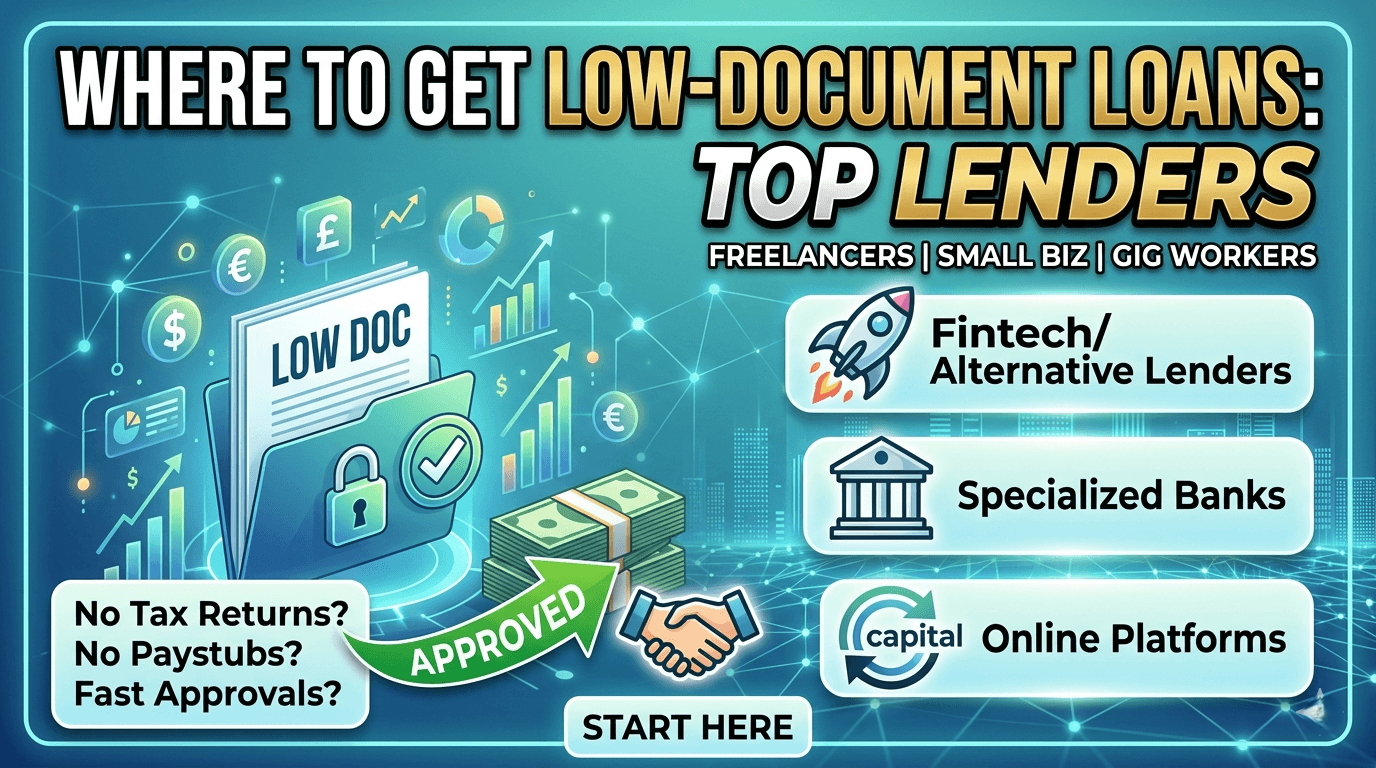
Where to Get Low-Document Loans: Top Lenders
A low-documentation (low-doc) loan is a mortgage or business loan where the lender does not require two years of traditional tax returns. Instead, the lender accepts alternative evidence of income, such as Business Activity Statements (BAS), consecutive bank statements, or a verified accountant’s letter. These loans are specifically designed for self-employed borrowers, freelancers, and small business owners who cannot provide standard income verification. For more insights on these options, read our guide on loans for self-employed individuals.
From Which Lenders are Low-Doc Loans Available?
As of 2026, specialist non-bank lenders—not the major banks—are the primary sources of these financial products.
Home Loan Market Leaders
- Pepper Money
- Liberty Financial
- La Trobe Financial
- Resimac
Business Loan Market Leaders
- Prospa
- Lumi
Before you apply, understand this: Low-doc loans carry higher interest rates (typically 7.3% to 11%) and exhibit higher historical default rates than standard full-doc loans.
The information provided above is systematically structured to assist you in choosing the correct alternative lender. If you are ready to explore your options, you can learn how to get a small business loan here.
What Qualifies as a Low-Document Loan?
APRA defines a low-documentation loan by what it does NOT require. A low-doc loan does NOT require two years of tax returns and ATO Notices of Assessment.
Instead, a low-doc lender accepts one of these alternatives:
- Business Activity Statements (usually 2–4 quarters)
- 6–12 months of business bank statements
- A signed letter from a TPB-registered tax agent or accountant
A declared income amount (you simply stating what you earn) is rarely accepted after 2024. Most lenders have removed this option entirely.
What is NOT a low-document loan?
Many borrowers confuse low-doc with other products. This leads to wasted applications.
No-doc loans require no income verification at all and are effectively extinct in the regulated market after 2009. If a lender offers a “no-doc” loan today, be extremely cautious.
Caveat loans are short-term, high-cost loans assessed on property equity and exit strategy, not income. Interest rates range from 14% to 48%.
Full-documentation loans with one missing document are not low-doc. If you have two years of tax returns but lost one payslip, that is an incomplete full-doc application, not a low-doc loan.
Why the Big Four Banks Are No Longer Viable Options
A rhetorical question: If the major banks have the lowest advertised rates, why would any borrower choose a specialist lender? The answer is simple – the majors will not approve your application.
Commonwealth Bank – The Quiet Exit
CBA effectively stopped accepting new low-doc applications from self-employed borrowers in late 2024. Their current policy requires two full years of lodged tax returns with matching ATO assessments. If you cannot provide these, CBA’s frontline assessment system will issue an automatic decline within 24 hours.
Westpac and NAB – Restricted to Existing Customers
Westpac will only consider low-doc refinancing for borrowers already holding a Westpac loan. NAB similarly restricts low-doc to existing business banking clients with at least 24 months of transactional history. New customers are directed to full-doc products or referred to third-party brokers.
ANZ – The Strictest Policy
ANZ requires a minimum two-year ABN registration, two years of BAS statements, and a credit score above 650.
In practice, fewer than 5% of self-employed applicants succeed with ANZ for low-doc loans.
The Refusal Cascade Problem
When you apply to a major bank and receive a refusal, that enquiry appears on your credit file. If you then apply to a second major bank, the second lender sees the first enquiry and often issues a second refusal automatically. Three enquiries within 90 days can drop your credit score by 60–90 points.
This cascade effect is poorly understood by most borrowers. A single refusal from a major bank often triggers automated declines from other major banks within the same week, because credit reporting bodies share enquiry data in near real-time. The practical solution is to apply to only one lender at a time, wait for a clear outcome, and use a broker who can conduct an informal assessment before any formal credit enquiry is lodged.
Statistic: According to APRA’s Quarterly ADI Statistics (March 2026), low-documentation loans now represent only 0.3% of all new residential lending, down from 1.2% in 2018. The major banks account for less than 0.1% of that share.
Expert quote: “Major banks have calculated that the compliance cost of verifying self-employed income exceeds the revenue from low-doc loans,” explains Sarah Chen, a former APRA risk analyst and now a consultant to non-bank lenders. “One file review that takes four hours instead of 30 minutes erases the profit margin. The majors decided to leave this market to non-banks willing to accept lower margins per loan in exchange for volume.”
Complete Lender List – Where to Apply in 2026
This section provides the actionable answer to the main question. Below is a comparison of the active low-doc lenders across residential and business products.
Low-Document Home Loan Lenders (Residential)
Low-Doc Lender Guidelines & Criteria Matrix
Comparative structural parameters for alternative income products as of 2026.
| Lender | Max LVR | Accepts BAS? | Accepts Accountant Letter? | Minimum ABN Age | Approx. Rate (2026) |
|---|---|---|---|---|---|
| Pepper Money | 80% | Yes (4 qtrs) | Yes | 12 months | 7.89% – 9.95% |
| Liberty Financial | 80% | Yes (2 qtrs min) | Yes (TPB registered) | 6 months | 7.29% – 8.99% |
| La Trobe Financial | 70% | Yes | Yes | 12 months | 8.50% – 10.95% |
| Resimac | 80% | Yes (4 qtrs) | No – BAS only | 24 months | 7.49% – 8.49% |
| Bluestone | 75% | Yes | Yes | 12 months | 8.95% – 11.95% |
| Thinktank | 70% | Yes | Yes | 24 months | 7.99% – 9.49% |
Two separate costs apply at high LVRs:
Risk fee (1–2% of loan amount): Charged by Pepper and Liberty for lending above 70% LVR without full tax returns. You can pay this upfront or add it to the loan balance.
Lenders Mortgage Insurance (LMI): Applies above 80% LVR at most lenders. LMI protects the lender, not you.
If your LVR is 80%, you may pay both a risk fee AND LMI. Always ask for a breakdown before signing.
Low-Document Business Loan Lenders
For business purposes (working capital, equipment, cash flow), the lender landscape is different. These products are typically unsecured and assessed on bank statements only.
Prospa – Accepts 6 months of business bank statements. Approval within 24 hours. Loans $5,000 – $500,000. Factor rates apply (not simple interest).
Lumi – Accepts 6 months of bank statements. No BAS required if ABN is active. Loans up to $500,000. 24-hour turnaround.
Moula – Requires 12 months of trading history. Accepts bank statements or accounting software feeds (Xero, MYOB). Loans $10,000 – $250,000.
Valiant Finance – Broker platform comparing 30+ business lenders. Useful if you have been refused elsewhere.
Real-world example – Business loan confusion: A Brisbane cafe owner borrowed $30,000 from Prospa at a factor rate of 1.25, expecting to repay $37,500 over 12 months. However, because factor rates are calculated on the original principal regardless of early repayment, paying the loan off in 6 months still cost $7,500 in fees – equivalent to a 50% annualised rate. The owner later told a Reddit forum: “I thought factor rates were just another way to say interest. I was wrong.”
Eligibility Criteria – What Lenders Actually Verify
Knowing which lenders accept low-doc applications is only half the answer. You must also understand what they verify and how strictly.
The Three Accepted Documentation Types
Lenders have a clear hierarchy of evidence. The higher your evidence ranks, the lower your interest rate.
Strongest evidence – Four quarters of BAS with matching bank deposits: Verifies GST turnover and banking behaviour simultaneously.
Moderate evidence – Accountant’s letter from a TPB-registered agent: Lenders will call the accountant using the number on the TPB register, not the letterhead.
Weakest evidence – Six to twelve months of bank statements: Triggers the highest interest rates and lowest LVR caps.
Real-world example – Accountant verification: A Melbourne-based graphic designer submitted an accountant’s letter with her low-doc application to Liberty Financial. The lender cross-referenced the accountant’s name against the TPB register and found the accountant’s registration had lapsed 60 days earlier. The application was declined. The borrower then paid $450 for a new letter from a TPB-registered accountant, resubmitted, and received approval within 10 days. The lesson: always verify your accountant’s TPB status before requesting a letter.
The Income “Haircut” Explained
Statistic: APRA requires lenders to apply a minimum 20% discount to any unverified income source.
How this works in dollars: Your BAS shows $120,000 annual turnover. The lender:
- Applies the 20% haircut → $96,000
- Applies a standard 30% expense ratio → $67,200
Bottom line: You need to earn approximately $96,000 in full-doc income to achieve the same borrowing power as $120,000 in low-doc turnover. This is not negotiable. Every low-doc lender follows this calculation.
Consider a concrete example. A self-employed courier deposits $8,000 per month into a business account. Of that, $2,000 is fuel reimbursement from a subcontractor (not income), $1,000 is a transfer from a personal account (not income), and $500 is a loan repayment from a family member (not income). After removing these non-income credits, the lender sees $4,500 per month. Apply the 20% haircut, and assessable income falls to $3,600 per month. This is why bank statement loans often disappoint borrowers.
The Two-Year Trading History Requirement
Most low-doc lenders require a minimum ABN registration period of 12–24 months. For borrowers with less than 12 months, options are extremely limited. Liberty Financial may consider 6 months with a stronger application (higher deposit, lower LVR), but interest rates start above 9%.
Case study – Short trading period: A freelance web developer with 9 months ABN history, $95,000 in bank deposits, and a 25% deposit on a $450,000 property applied to Liberty Financial. The lender approved a 65% LVR loan at 8.95% with a 1.5% risk fee. The same borrower was refused by Resimac (required 24 months) and Pepper Money (required 12 months).
Interest Rates, Fees, and the True Cost of Low-Doc
Low-documentation loans are more expensive than full-doc loans. The reasons are regulatory and actuarial, not arbitrary.
Rate Comparison Table (June 2026)
Interest Rate & Fee Structure Matrix
Direct premium market comparison between traditional full-doc options and low-doc structures.
| Loan Type | Typical Rate Range | Comparison Rate Range | Establishment Fee |
|---|---|---|---|
| Full-doc (major bank) | 5.99% – 6.49% | 6.10% – 6.70% | $0 – $600 |
| Full-doc (non-bank) | 6.29% – 6.89% | 6.50% – 7.20% | $300 – $800 |
| Low-doc (BAS + accountant) | 7.29% – 8.49% | 7.80% – 9.20% | $500 – $1,500 |
| Low-doc (bank statements only) | 7.89% – 9.49% | 8.50% – 10.50% | $800 – $2,000 |
| Low-doc (impaired credit) | 8.95% – 10.95% | 10.00% – 13.00% | $1,000 – $2,500 |
Read the table this way: If you can provide BAS statements, expect rates starting at 7.29%. If you can only provide bank statements, expect rates starting at 7.89%. If your credit score is below 600, add 1–2% to any of these figures.
Hidden Costs Beyond the Interest Rate
Three costs routinely surprise low-doc borrowers:
Risk fee – 1–2% of the loan amount, charged for LVRs above 70% or credit scores below 600.
Monthly account fee – $15–$30 per month, compared to $0–$10 for full-doc loans.
Solicitor review fee – Some low-doc lenders charge $250–$500 to review complex trust structures or multiple business entities. This fee is non-refundable even if the application is declined.
Early exit fee – Several non-bank lenders impose a penalty of 1–2% of the outstanding balance if you refinance within the first 24 months. Always check the “early repayment” section of the loan contract.
Valuation fee – $300–$800, often required upfront before conditional approval.
Statistic: A $500,000 low-doc loan at 8.5% over 30 years costs $384,000 in interest. The same loan at 6.5% costs $255,000 – a difference of $129,000. This is why switching to full-doc as soon as you have two years of tax returns is critical.
Expert quote: “The most dangerous borrower is the one who sees low-doc as a permanent solution,” warns Michael Tran, a mortgage broker with 15 years of self-employed lending experience. “I tell every client: low-doc is a bridge. Your goal is to get two clean tax returns on file within 24 months, then refinance. Borrowers who treat low-doc as ‘business as usual’ pay an extra $100,000 or more over the life of the loan. I’ve seen it happen three times this year alone.” For more details on navigating these options, you can consult this self-employed loan guide.
The Switch Strategy
Most non-bank lenders allow you to refinance to a full-doc product with the same lender after 12–24 months, provided you can produce two years of lodged tax returns and ATO assessments. The refinance typically waives the establishment fee but may require a new valuation.
Real-world example – Valuation shortfall: A Sydney sole trader applied to Pepper Money for an 80% LVR low-doc loan on a $900,000 apartment. Pepper’s valuation came back at $780,000 – 13% below the purchase price. The borrower needed an additional $96,000 in cash to maintain the 80% LVR. Without those funds, the loan was restructured to 65% LVR at a higher rate (9.25% instead of 7.89%). The borrower later discovered that low-doc lenders routinely use more conservative valuers than major banks. The solution is to order your own valuation before applying, not after.
Case Study – From Refusal to Approval
This real-world scenario demonstrates the correct lender selection process.
Borrower profile: Married couple. Husband is a self-employed builder with 22 months ABN history. Wife is a part-time employee earning $45,000. Their tax return shows $52,000 combined income after business deductions. Bank statements show $145,000 in deposits over 12 months.
Initial mistake: They applied to CBA, believing a long-standing transaction account would help. CBA refused within 48 hours citing “insufficient verified income.”
Correct strategy: A broker redirected them to Pepper Money using 4 quarters of BAS (showing $148,000 turnover) and the wife’s payslips. Pepper applied the 20% discount to BAS income ($118,400), added wife’s $45,000, then applied expense ratios. Assessable income came to $98,000 – sufficient for a $420,000 loan at 75% LVR.
Outcome: Approval at 8.25% with a 1.25% risk fee capitalised. The couple accepted and will refinance to full-doc in 14 months once two full tax returns are lodged.
Key lesson: The couple applied to CBA first – the wrong lender – and lost two weeks. When redirected to Pepper Money, they received conditional approval in four days. If they had started with a specialist non-bank lender, they would have saved the credit enquiry from CBA and the associated 15-point credit score drop.
Frequently Asked Questions (12 Questions)
1. Can I get a low-doc loan with no ABN?
No. Every regulated low-doc lender requires a valid ABN registered for a minimum period. The only exception is a full-doc loan using a partner’s income as guarantor.
2. What is the minimum credit score for low-doc approval?
Pepper Money accepts scores as low as 500 (higher rates apply). Liberty requires 550 minimum. La Trobe requires 580. For scores below 500, only private lenders (caveat loans) are available.
3. How long does low-doc approval take?
For home loans: 7–21 days from application to unconditional approval. For business loans: 24–72 hours.
4. Can I use an accountant’s letter instead of BAS?
Yes, but the accountant must be TPB-registered, and the lender will verify their registration and call them directly. Accountant letters typically result in a higher interest rate than full BAS.
5. Do low-doc loans require Lenders Mortgage Insurance?
LMI applies above 80% LVR. Most low-doc lenders cap at 80% LVR, but some (Pepper, Liberty) offer 85–90% LVR with LMI and a risk fee.
6. Can I refinance from a low-doc loan to a major bank later?
Yes, but only after you have two full years of tax returns and ATO assessments showing sufficient income. The major bank will treat this as a full-doc application.
7. What happens if my BAS and bank statements don’t match?
Variance above 15–20% triggers a decline. Lenders expect explained discrepancies (e.g., cash not banked, which is itself a compliance risk).
8. Can I apply for a low-doc loan if I have a current ATO payment plan?
Yes, but with significant restrictions. Most low-doc lenders will only accept an ATO payment plan if the debt is less than $10,000, the payment plan is current (no missed instalments), and you have made at least three consecutive payments. Debts above $10,000 or any debt that has been referred to a collection agency will result in an automatic decline at all non-bank lenders except La Trobe Financial, which may accept payment plans up to $25,000 with a higher risk fee.
9. How long does a low-doc approval remain valid before I need to reapply?
Most low-doc loan approvals are valid for 90 days from the date of conditional approval, compared to 120 days for full-doc loans. The shorter validity period reflects the lender’s concern that your business income may change rapidly. If you do not settle within 90 days, you must submit updated bank statements (the most recent 3 months) and a fresh accountant’s letter or BAS statements. Some lenders, including Pepper Money, charge a $250 extension fee for a 30-day renewal.
10. Can I use rental income from an investment property in a low-doc application?
Yes, but rental income is treated differently depending on the lender. Liberty Financial accepts 80% of gross rental income from a property with a current lease agreement (no haircut beyond the standard 20% applied to business income). Pepper Money requires a rental appraisal from a registered valuer and applies the same 20% discount to rental income as it does to business income. Resimac does not accept rental income at all in low-doc applications unless the borrower has owned the investment property for at least 12 months.
11. Are low-doc loans available for investment properties?
Yes. Most low-doc lenders allow investment purchases, but maximum LVR typically drops to 70–75% (compared to 80% for owner-occupier).
12. What happens to my low-doc loan if my business fails or my income drops significantly?
This is a critical risk that lenders do not advertise. Low-doc loans have fewer hardship protections than full-doc loans because the original assessment was based on unverified income. If you miss two consecutive repayments, the lender is likely to issue a default notice within 30 days (compared to 60–90 days for major bank full-doc loans). Some non-bank lenders, including Bluestone, reserve the right to increase your interest rate by 2–4% upon default. The safest option is to maintain a cash buffer of at least three months of repayments in a separate account before taking out a low-doc loan.
Final Recommendations
If you are self-employed or operate a small business, low-documentation loans remain available, but you must apply to the correct lender. Pepper Money and Liberty Financial are the most flexible for home loans with shorter trading histories. Prospa and Lumi lead the business loan market for speed and accessibility. The major banks – CBA, Westpac, NAB, and ANZ – are no longer viable options for new low-doc applicants.
Is it worth paying a 1–2% premium for a low-doc loan today if it allows you to buy a property or grow your business now, rather than waiting two years for full tax returns? For most self-employed borrowers, the answer is yes – provided you have a clear plan to refinance to a full-doc loan within 24 months.
Before applying to any lender, complete this three-step checklist:
Step 1: Check your credit score at Equifax or illion. If below 550, start with La Trobe or Bluestone.
Step 2: Prepare 12 months of bank statements and 4 quarters of BAS (if available).
Step 3: Speak to a broker who specialises in self-employed finance. A good broker costs you nothing (lenders pay them) and prevents the refusal cascade.
The right application to the right lender succeeds. The wrong application damages your credit and wastes months of opportunity.
Summary Table: Recommended Lenders by Scenario
Lender Matching Recommendation Matrix
Strategic structural matchings mapping borrower circumstances to top alternative providers as of 2026.
| Your Situation | Recommended Lender | Max LVR | Approx Rate |
|---|---|---|---|
| 12+ months ABN, good credit | Pepper Money | 80% | 7.89% |
| 6+ months ABN, higher deposit | Liberty Financial | 80% | 7.29% |
| Impaired credit (500–580) | La Trobe Financial | 70% | 8.95% |
| Business loan, fast approval | Prospa | N/A | Factor rate 1.2–1.4 |
| Business loan, bank statements only | Lumi | N/A | From 12% p.a. |
Disclaimer: Interest rates and lender policies change. Always verify current rates and eligibility directly with the lender or your mortgage broker before applying.