Introduction
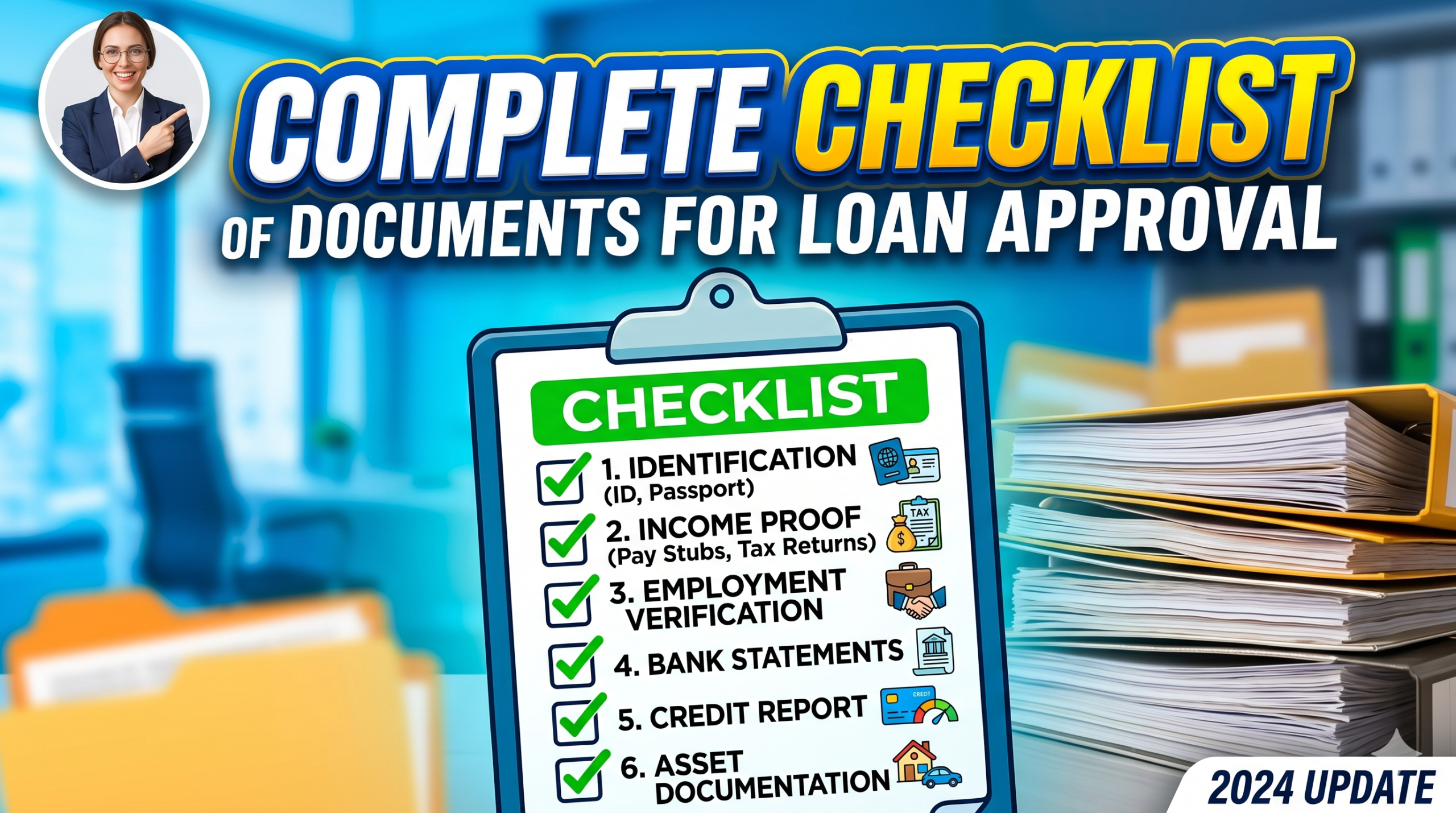
Complete Checklist of Documents for Loan Approval
When a loan officer rejects an application, the reason is rarely a low credit score alone.
Do this now: Gather the documents listed below before you complete any loan application form. This checklist follows standard lender requirements across personal, home, auto, business, and education loans.
Have you ever submitted what you thought was a complete file only to receive a request for “additional information” two weeks later? Have you wondered why a lender asks for three months of bank statements when you already provided a salary certificate?
This guide answers those questions with reference to actual lender verification policies. Every document requirement below includes a specific timeframe and an explanation of why lenders request it. If you haven’t decided where to apply yet, you may also want to understand the differences between a Bank vs NBFC vs Online Lender before submitting your paperwork.
Document Timeframe Reference Table
Before reviewing the detailed checklist, use this table to understand how far back lenders look for each document type.
| Document Type | Salaried Applicant | Self-Employed Applicant |
|---|---|---|
| Pay stubs | Last 30 days | Not applicable |
| Bank statements | Last 2-3 months | Last 6-12 months |
| Tax returns / ITR | Last 1 year (Form 16) | Last 2-3 years |
| Address proof | Last 3 months | Last 3 months |
| Employment verification | Last 30 days | Last 30 days (business proof) |
| Business financials | Not applicable | Last 3 years audited |
Critical note: Documents outside these timeframes will be rejected as stale. A pay stub from four months ago is not acceptable. A bank statement from last year does not count.
Identity and Address Proof (What Every Lender Needs First)
Every lender must verify who you are and where you live. This is called KYC (Know Your Customer). It is non-negotiable.
Acceptable identity documents:
- Passport (must be valid and unexpired)
- PAN card (for Indian applicants)
- Aadhaar card (for Indian applicants)
- Driver’s license (valid)
- Voter identification card
- Government-issued national ID (other countries)
Critical requirement: The name on your identity document must match the name on your income documents and bank statements exactly. A mismatch of even a middle initial or a shortened first name triggers a verification flag. For married applicants whose surname changed, you must provide a marriage certificate or an affidavit explaining the name variation.
What is NOT accepted as identity proof:
- Expired passports or driver’s licenses
- College or employee ID cards
- Photocopies without self-attestation
- Digital images from mobile phones (original scan required)
Address proof requirements: Lenders accept utility bills (electricity, water, gas), rental agreements, property tax receipts, or bank statements. The address document must be dated within the last three months.
Common rejection: A utility bill that is four months old will be rejected. Check the date on every address document before submitting.
Income Proof for Salaried Employees
If you work for a company and receive a monthly salary, you must provide these three documents.
Document 1: Latest three months of pay stubs
These must show your gross salary, deductions, and net pay. The employer’s name and logo should be clearly visible.
Document 2: Form 16 or annual tax statement
This serves as official proof of income verified by tax authorities. It shows how much tax you paid and confirms your declared income.
Document 3: Employment verification letter
This must be issued by your employer within the last 30 days. It should confirm your job position, how long you have worked there, and your current salary.
Why three months of pay stubs? Lenders look for consistency. A single month of unusually high or low salary raises questions. If your December pay stub includes a bonus, the lender will request the previous two months to establish your base salary.
Expert Quote – Former Bank Loan Officer (15 years experience):
“The most common mistake I saw was salaried applicants submitting pay stubs without their employer’s official letterhead or stamp. We rejected those immediately. A pay stub from a standard printer paper without company branding looks like it could have been typed at home. Always request official copies from HR.”
Income Proof for Self-Employed and Gig Workers
If you own a business, work as a freelancer, or earn money from platforms like Uber or Fiverr, you face stricter scrutiny. You must provide these documents.
Document 1: Last two to three years of income tax returns (ITR)
Lenders prefer continuity. A gap in filing or last-minute filing signals financial disorganization. If you skipped a year of filing, expect questions or rejection.
Document 2: Audited financial statements (if your annual turnover is large)
This includes profit and loss statement, balance sheet, and cash flow statement prepared by a chartered accountant.
Document 3: GST returns (if applicable)
These must align with the turnover reported in your ITR. If your GST returns show ₹25 lakh turnover but your ITR shows ₹15 lakh income, the lender will flag the mismatch.
Document 4: Bank statements showing business income deposits
Six to twelve months preferred. Lenders want to see regular deposits from clients or customers.
What is NOT accepted for self-employed applicants:
- ITR filed after the loan application date
- Bank statements without business income entries
- GST returns that show zero turnover for more than three months
- Handwritten account books without auditor certification
For gig workers (Uber, Fiverr, Upwork): You do not have traditional pay stubs. Provide twelve months of platform payout summaries alongside bank statements showing consistent deposits of similar amounts each month.
Real-world example: Priya, a freelance graphic designer, applied for a personal loan with her ITR showing ₹4.2 lakh income but bank statements showing ₹7.8 lakh in client payments. The lender flagged the 85 percent variance. She provided a letter from her chartered accountant explaining that the ITR reflected income after expenses (software subscriptions, hardware depreciation), while bank statements showed gross receipts. The loan was approved after the explanation was accepted.
Bank Statements and Asset Verification
Every loan application requires bank statements from all your active accounts. The standard requirement is three to six months of statements, though home loans may require twelve months.
What lenders examine in your bank statements:
| Red Flag | Why It Matters | Acceptable Explanation |
|---|---|---|
|
Alert Large unverified deposit |
May be a hidden loan or undisclosed income source. | Gift deed + donor’s bank statement. |
|
Alert Multiple transfers between your own accounts |
Creates a misleading average balance reading for lenders. | No action needed, but lender may explicitly ask for clarification. |
|
Alert Overdraft or bounced cheque |
Indicates immediate cash flow issues and poor financial management. | None – directly impacts and lowers approval chance. |
|
Alert Regular payments to unknown parties |
Could be undisclosed EMIs (Equated Monthly Instalments) eating your income limit. | Loan statements directly from those respective parties. |
What is NOT accepted as bank statement proof:
- Screenshots from mobile banking apps
- Transaction summaries without bank logo
- Statements missing the first and last page
- Statements older than 90 days from application date
Critical instruction: Do not transfer money between your own accounts or accept large third-party deposits in the three months before applying. Every deposit that is not your regular salary or business income requires a documented explanation.
Expert Quote – Credit Analyst at National Bank:
“We see applicants move money from their savings account to their checking account two weeks before applying, thinking it shows more cash on hand. What it actually shows us is that the applicant doesn’t understand cash flow. We ask for both account statements and then we see the transfer. Nothing is hidden. Be honest about your true cash position from the start.”
Home Loan Additional Documents
When applying for a home loan, you must prove both your income and the property’s legal standing. Add these documents to your checklist.
Required documents:
- Sale agreement or construction agreement (signed by both buyer and seller)
- Property tax receipts for the last three years
- Encumbrance certificate (proves the property has no legal or financial claims against it)
- Approved building plan (for under-construction property)
- Occupancy certificate (for ready-to-move-in property)
- NOC from the builder or society
The most commonly missed document: Gift deed for down payment funds. If any portion of your down payment came from a family member, you must provide a notarized gift deed plus the donor’s bank statement showing the withdrawal. Without these documents, the lender assumes the gifted amount is an undisclosed loan that affects your debt-to-income ratio.
Real-world example: Amit received ₹8 lakh from his father for a home loan down payment. He deposited the amount and submitted three months of bank statements with his application. The lender noticed the deposit and requested documentation of its source. Amit had no gift deed. His application was paused for four weeks. After obtaining a notarized gift deed, his father’s bank statement showing the withdrawal, and a copy of his father’s PAN card, the loan was approved. The delay cost him a 0.5 percent interest rate increase because rates changed during the waiting period.
Auto Loan, Business Loan, and Education Loan Documents (180 words)
Auto loan documents:
- Proforma invoice from the dealer (shows the on-road price)
- Vehicle registration certificate (for used vehicles – must be transferred to your name)
- Insurance policy (comprehensive coverage valid for at least one year)
- Proof of down payment (bank statement showing the amount paid to the dealer)
What is NOT accepted for auto loans:
- Insurance policy with less than 6 months validity remaining
- RC that still shows the previous owner’s name
Business loan documents:
- GST registration certificate
- Business vintage proof (partnership deed, incorporation certificate)
- Last three years of audited balance sheets
- Last six months of business bank statements
- Projected financials (to justify the loan amount)
Real-world example: A small manufacturing business applied for a ₹20 lakh working capital loan. The owner submitted two years of ITR but had not filed GST returns for the previous six months because the business had temporarily stopped operations. The lender rejected the application due to the GST filing gap.
Education loan documents:
- Admission letter from the institution
- Fee schedule (broken down by semester or year)
- Co-applicant income proof (usually parent or guardian)
- Collateral documents (property papers, fixed deposit receipts for larger loans)
What Lenders Verify Independently (You Do Not Need to Submit) (120 words)
You do not need to submit documents for these items. Lenders will check them directly using their own systems.
- Your credit score and credit history (via credit bureau)
- Your employer’s existence and your employment status (via phone or email)
- Property ownership records (via government land records)
- Tax filing status (via income tax portal)
- Existing loan exposures (via credit bureau reports)
Why this matters: Do not attempt to inflate your income or hide existing loans. Lenders will discover these independently. False information will result in automatic rejection and a flag on your credit record that affects future applications.
What to Do When a Document Is Missing
No applicant has every document perfectly prepared. The difference between approval and rejection lies in how you handle missing items.
Acceptable alternatives for common missing documents:
| Missing Document | Acceptable Alternative | Conditions for Use |
|---|---|---|
| PAN card | Form 60 |
Only applicable for small loan brackets fall under specified legal tax thresholds.
|
| Salary slip (one month) | Bank statement showing salary credit |
Transaction figures must explicitly match preceding consecutive months’ verified deposit volumes.
|
| Original property tax receipt | Online payment receipt + portal screenshot |
Visuals must clearly display corresponding fiscal assessment year and exact unique property ID.
|
| Employer verification letter | Appointment letter + recent promotion letter |
Typically accepted seamlessly for existing, pre-vetted banking accounts holders of the same institution.
|
Fixing name mismatches: If your PAN card shows “R. Sharma” and your Aadhaar shows “Rajesh Sharma,” obtain a notarized affidavit stating that both names refer to the same person. Attach any supporting document such as a marriage certificate.
Sample affidavit format: “I, Rajesh Sharma (also known as R. Sharma), son of [father’s name], resident of [address], do hereby solemnly affirm that both names belong to one and the same person. This affidavit is made for the purpose of loan application.”
Digital Document Preparation Standards
Lenders reject poorly formatted digital submissions. Follow these standards to avoid rejection.
Format rules:
- PDF format only (No JPEG, PNG, or Word documents)
- Maximum 5 MB per file
- Clear, readable scans (200 DPI minimum, no shadows or glare)
File naming convention: [DocumentType]_[YourName]_[Date].pdf
- Example:
03_BankStatement_RajeshSharma_2025-01.pdf
Why naming matters: Loan processors review hundreds of files. A folder named “scans” with files named “IMG_001.pdf” through “IMG_020.pdf” creates processing delays of two to three days. Organized, clearly named files move to the front of the queue.
Post-Approval Documents Required (120 words)
Approval is not the final step. Within 7-14 days of approval, you must typically submit:
- Life insurance policy assigned to the lender (for secured loans over a certain amount)
- Signed deed of loan or promissory note
- Salary declaration authority (for payroll deduction loans)
- Post-dated cheques (if required by lender)
Consequence of missing post-approval deadlines: If you fail to submit these documents within the specified timeframe, the lender may withdraw the approval and cancel the loan offer. You would then need to reapply, often with a new credit check.
Document Processing Timeline
Understanding what happens after submission helps you respond promptly to requests.
Application Submitted
Initial Document Verification
Credit Check & Income Verification
Underwriting Review
Approval or Rejection Decision
Loan Disbursement
Frequently Asked Questions (12 Questions) (400 words)
1. Can I get a loan approved without income proof?
Very difficult for unsecured loans. Alternatives include secured loans against fixed deposits, gold, or property. Some lenders offer small loans (under ₹50,000) with minimal documentation to existing salary account customers.
2. How many months of bank statements do most lenders require?
Three to six months for personal and auto loans. Six to twelve months for home and business loans. Self-employed applicants should provide twelve months regardless of loan type.
3. What is a gift deed? Is it legally mandatory?
A gift deed is a notarized document stating that money received from a family member is a gift, not a loan. For home loan down payments, most lenders require it. Without it, the lender assumes the gift is an undisclosed liability.
4. Do I need to submit original documents or are copies sufficient?
Self-attested copies (each page signed and dated) are sufficient for initial application. Lenders will request original documents for verification at the time of loan disbursement.
5. How do I correct a name mismatch across my documents?
Obtain a notarized affidavit stating that both names refer to the same person. Attach supporting documents such as a marriage certificate or gazette notification.
6. Can I apply for a loan with a co-applicant? What documents does the co-applicant need?
Yes. The co-applicant must submit the full set of KYC, income proof, and bank statements. You cannot skip documentation for a co-applicant simply because they have lower income.
7. What if my address on Aadhaar differs from my current residence?
Use an alternate address proof: passport, voter ID, rental agreement, or utility bill dated within three months. Most lenders accept these in place of Aadhaar address.
8. How long are income documents valid for a loan application?
Salary slips: three months. Form 16 or ITR: 12 months from the assessment year. Bank statements: three months. Employment verification letters: 30 days.
9. Can NRIs apply for a loan in India with foreign documents?
Yes. NRIs need a passport with valid visa, overseas bank statements (six to twelve months), salary certificates from foreign employer, and a power of attorney authorizing someone in India to complete documentation.
10. What is the fastest way to organize documents for a loan application?
Create a folder with subfolders labeled: 01_KYC, 02_IncomeProof, 03_BankStatements, 04_LoanSpecific. Convert all documents to PDF. Name each file using the format DocumentType_YourName_Date.pdf.
11. How long do I have to submit documents after applying online?
Most lenders require all documents within 7 calendar days of submitting the online application. Missing this deadline cancels your application.
12. What happens to my application if a document is rejected?
The lender will place your application on hold and request a replacement document. You typically have 5-7 days to provide the corrected document.
Conclusion
A complete document checklist is not a guarantee of loan approval, but missing documents are a guaranteed cause of delay or rejection. Review each category in this guide. Verify that names match exactly across all papers. Check that every deposit in your bank statements is either regular income or supported by a gift deed. Organize your digital files before you submit.
Have you checked your document expiry dates? Complete these steps now, and your application will move through processing faster than 70 percent of incomplete submissions.
⚠️ Important: Lender document requirements change periodically. Always confirm with your specific lender before submitting, as requirements vary by institution and loan product.