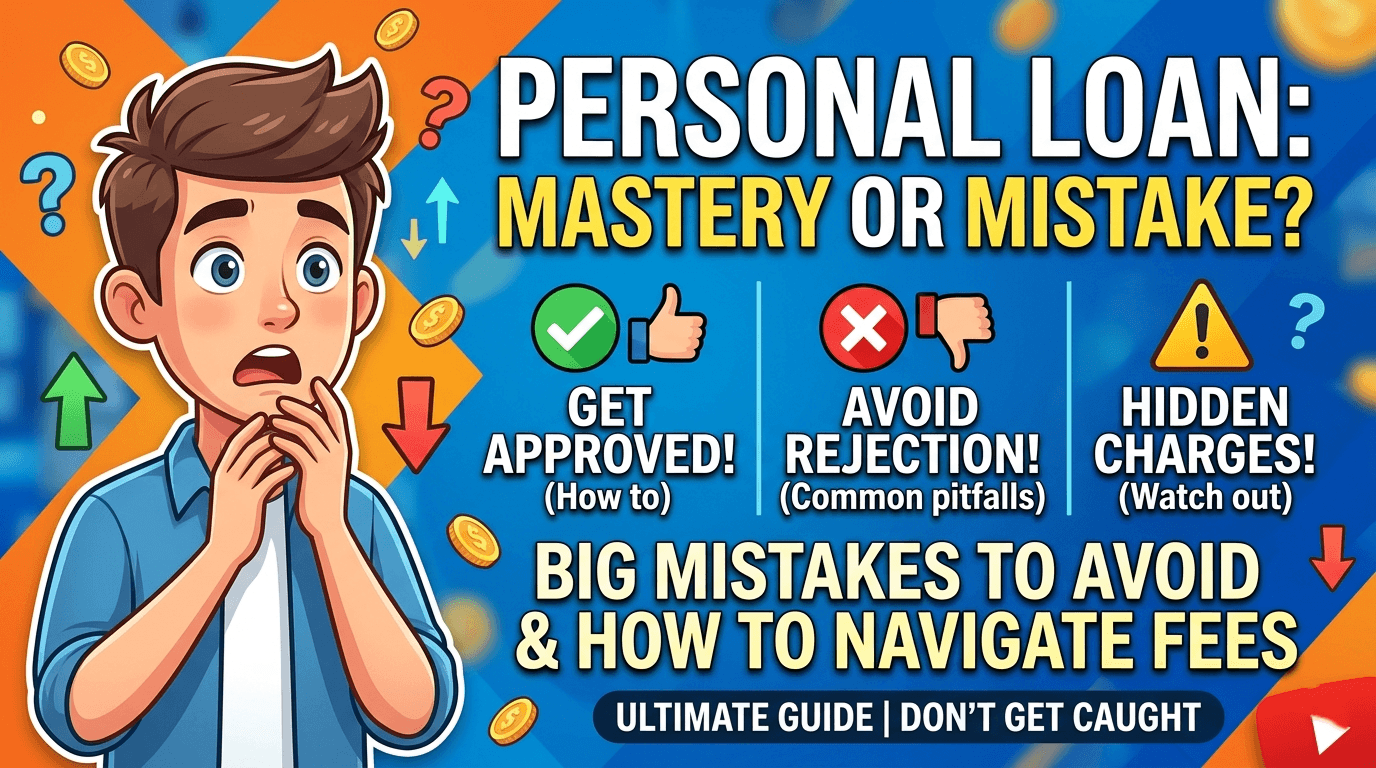
When you apply for a personal loan, three outcomes determine your financial stability: approval at favorable terms, approval with punitive charges, or outright rejection. Each outcome is governed by a set of borrower actions—and mistakes—that are entirely preventable.
This guide examines the eight most critical errors that trigger hidden charges, automatic rejection, or both. It answers the central question: Why do qualified applicants still face rejection or unexpected penalties? The answer lies not in lender malice but in borrower non-compliance with credit underwriting rules, fee disclosure protocols, and post-rejection waiting periods.
Have you ever been rejected despite a good salary? Have you paid a prepayment penalty you didn’t expect?
These are not accidents. They are consequences of overlooked rules. This document provides the regulatory framework, real case studies, and a post-rejection action plan to ensure your next application succeeds.
Mistake #1 – Applying Without First Reviewing Your Credit Score
The Minimum Score Requirement
Most lenders set a minimum CIBIL score of 750 for standard interest rates. Borrowers with scores between 650 and 749 may receive offers but at higher rates (12–18% versus 10–12%). Scores below 650 trigger automatic rejection at over 60% of banks.
How Rejection Occurs
When you apply without knowing your score, the lender performs a hard inquiry. If your score is below 650, the system rejects the application immediately. You have now incurred one hard inquiry and a rejection with no benefit.
The Statistic You Must Know
According to CIBIL’s 2025 report, 62% of personal loan rejections are directly attributable to a credit score below the lender’s threshold. Borrowers who checked their score beforehand reduced rejection rates by 47%.
Required Action
Obtain your free annual credit report from all four bureaus (CIBIL, Experian, Equifax, CRIF High Mark). Dispute any errors before applying. A single incorrect late payment entry can drop your score by 50–80 points.
Rhetorical question: Would you attempt a driving test without knowing the passing score? Then why apply for a loan without knowing your credit score?
Mistake #2 – Making Multiple Applications in a Short Period
Hard Inquiries Explained
Each formal loan application triggers a hard inquiry. Credit bureaus record every inquiry. When a lender sees four or more hard inquiries within 14 days, their algorithm flags you as “credit-hungry”—an applicant desperately seeking any approval.
The Score Drop Consequence
Every hard inquiry reduces your credit score by 5–10 points. Four applications lower your score by 20–40 points. A borderline applicant at 660 drops to 620, moving from “possible approval” to “automatic rejection.”
Real Case Study
Ramesh, a salaried professional, needed ₹3 lakh urgently. He applied to four lending apps in eight days. His score fell from 745 to 705. All four rejected him. He then approached his regular bank, which cited “recent multiple inquiries” as grounds for denial. He waited 90 days, made zero applications, and was approved on the fifth attempt.
The Compliance Rule
Lenders are required to report hard inquiries accurately, but no rule limits how many inquiries you can generate. The burden is on you to space applications 30–45 days apart. Use loan aggregators with “soft check” features that do not affect your score.
Rhetorical question: If four job applications in one week hurt your professional reputation, why would four loan applications in one week help your credit reputation?
Mistake #3 – Ignoring Hidden Charges and Fee Structures
The Difference Between Interest Rate and APR
Banks advertise an interest rate (e.g., 11% p.a.). The Annual Percentage Rate (APR) includes interest plus processing fees, GST, documentation charges, statement fees, and late payment penalties. The APR is typically 6–12% higher than the advertised rate.
Comprehensive Fee Table
| Charge Type | Typical Amount | Trigger Event |
|---|---|---|
| Processing Fee | 1–3% of loan amount | At sanction |
| GST on Processing Fee | 18% of processing fee | At sanction |
| Documentation/Stamp Duty | ₹500–₹2,000 | At disbursement |
| Late Payment Penalty | ₹500–₹1,000+ per month | Each missed EMI |
| Foreclosure/Prepayment Charge | 2–5% of principal prepaid | Early closure (fixed-rate loans only) |
| Statement/Coupon Book Fee | ₹50–₹200 per statement | Monthly or on request |
| No-Dues Certificate Fee | ₹100–₹500 | After full repayment |
Real Case Study
Priya accepted a “0% interest festival loan” of ₹50,000. Her actual costs: ₹2,500 processing fee (5%), ₹450 GST, ₹1,000 documentation fee, and ₹500 late payment fee when she paid three days late. Total charges: ₹4,450, or 8.9% of the principal. She paid more in fees than she would have paid in interest on a standard 10% loan.
The Borrower’s Right
Under the RBI’s Key Facts Statement (KFS) mandate, every lender must provide a standardized document showing the APR, total repayment amount, and all fees—including critical details on prepayment and foreclosure charges—before you sign. If a lender does not provide a KFS, do not proceed.
Rhetorical question: Would you buy a car without knowing the on-road price including taxes? Then why accept a loan without knowing the APR?
Our Latest Post: Hidden Personal Loan Charges: A 2026 Borrower’s Guide
Our Latest Post: 10 Personal Loan Mistakes to Avoid Before You Borrow
Mistake #4 – Overlooking Your Debt-to-Income Ratio (DTI)
The Calculation Formula
Debt-to-Income Ratio = (Total Monthly EMI Obligations ÷ Monthly Net Income) × 100
Example: Monthly income = ₹50,000. Existing EMIs = ₹20,000. DTI = 40%.
The Approval Threshold
Most lenders reject applications where DTI exceeds 50%. NBFCs may allow up to 55%, but with higher interest rates. RBI supervisory data indicates that 78% of rejected personal loan applicants had a DTI exceeding 45%.
How to Fix High DTI Before Applying
- Close small-ticket loans or credit card balances first
- Request a co-signer to share the EMI obligation on paper
- Wait until an existing loan’s tenure ends (reducing monthly EMI)
- Increase net income through documented additional earnings
The Hidden Consequence
Even if approved with high DTI, your interest rate increases by 2–4%. On a ₹5 lakh loan over three years, that adds ₹15,000–₹30,000 in extra interest.
Mistake #5 – Ignoring Prepayment Penalty Rules
The New RBI Rule (Effective January 1, 2026)
Under the RBI (Pre-payment Charges on Loans) Directions, 2025, no lender can charge prepayment or foreclosure fees on floating-rate personal loans for non-business purposes. This applies to all loans sanctioned or renewed on or after January 1, 2026.
What This Means for You
If your loan has a floating interest rate, you may prepay any amount at any time without penalty. There is no minimum lock-in period.
The Exception You Must Know
FFixed-rate personal loans are not covered by this rule. Lenders may still charge 2–5% prepayment penalties on fixed-rate loans. Always check your sanction letter for the phrase “floating rate” or “fixed rate.”
Action Item
For existing loans (pre-2026), request a letter from your lender confirming whether prepayment charges apply. Many lenders voluntarily waived charges after the RBI direction.
Mistake #6 – Reapplying Immediately After Rejection
The 90-Day Waiting Period
After a rejection, you must wait a minimum of 90 days before reapplying. Applying sooner guarantees another rejection because:
- Your credit report still shows the prior hard inquiries
- Your DTI has not changed
- The reason for rejection (e.g., low score) remains unaddressed
The Required Action Plan
- Obtain the written rejection reason from the lender (RBI Fair Practices Code requires this)
- Check your credit report for errors
- Dispute any incorrect entries (allow 30 days for resolution)
- Reduce DTI by closing smaller debts
- Wait 90 days from the last hard inquiry date
What Rejection Does Not Do
Rejection itself does not lower your credit score. Only the hard inquiry accompanying the application lowers your score. Borrowers often mistakenly believe the rejection letter carries a penalty—it does not.
Mistake #7 – Borrowing More Than You Need
The Impulse Borrowing Trap
Taking a loan for discretionary expenses (vacations, electronics, weddings) creates unnecessary interest burden. When buyers’ remorse sets in, prepayment penalties (on fixed-rate loans) add further cost.
Example of Wasted Charges
A ₹2 lakh loan for a vacation at 12% interest over two years costs ₹24,000 in interest. If you repay in six months, a 4% prepayment penalty adds ₹8,000. Total cost for “free money” = ₹32,000.
The Compliance Perspective
Borrow only for needs that appreciate or stabilize your financial position: medical emergencies, education, or debt consolidation at lower rates.
Mistake #8 – Ignoring the Fine Print on Co-Signer Liability
Equal Liability Clause
When you add a co-signer, they become jointly and severally liable. If you default, the lender can recover the full amount from the co-signer’s assets or income without first pursuing you.
Required Disclosure
The RBI mandates that lenders explain co-signer liability in clear language. If the explanation is not provided, the agreement may be challenged.
Best Practice
Use a co-signer only when your DTI is borderline (45–50%) and you have a fixed repayment plan. Never ask a co-signer to guarantee a loan for discretionary spending.
Post-Rejection Action Plan – Step-by-Step Checklist
- Request written rejection reason – Send an email to the lender’s grievance officer.
- Obtain all four credit reports – CIBIL, Experian, Equifax, CRIF High Mark.
- Dispute errors – Each bureau has a 30-day dispute resolution process.
- Reduce DTI – Pay off one small loan or credit card completely.
- Wait 90 days – No new applications during this period.
- Apply with one lender – Use a pre-approved offer from an existing bank where you have a salary account.
- Request Key Facts Statement – Review APR and prepayment terms before signing.
Frequently Asked Questions (FAQ) – 10 Questions
1. What is the minimum CIBIL score for a personal loan?
Most lenders require 750 for best rates. Scores 650–749 may get approval with higher interest. Below 650 leads to rejection at over 60% of banks.
2. Do multiple loan inquiries hurt my credit score?
Yes. Each hard inquiry reduces your score by 5–10 points. Four inquiries = 20–40 point drop.
3. Can I prepay my personal loan without penalty?
Yes, for floating-rate loans sanctioned after January 1, 2026. Fixed-rate loans may still charge 2–5%.
4. What hidden charges should I look for?
Processing fee, GST on fees, documentation fee, late payment penalty, prepayment penalty, statement fee, no-dues certificate fee.
5. How long should I wait after a personal loan rejection?
Minimum 90 days. Use this time to fix the reason for rejection.
6. What is a debt-to-income ratio, and why does it matter?
It is your total monthly EMIs divided by monthly income. Lenders reject DTI above 50%.
7. Does a personal loan rejection affect my CIBIL score?
No. Only the hard inquiry affects your score. The rejection itself leaves no mark.
8. Can a co-signer help me get approved after rejection?
Yes. A co-signer with high credit score (775+) and low DTI can reverse a rejection.
9. What is a Key Facts Statement (KFS)?
An RBI-mandated document showing APR, total repayment amount, and all fees before you sign.
10. Are there any charges if my loan application is rejected?
No. Lenders cannot charge processing fees on rejected applications. If they do, file an RBI Ombudsman complaint.
Conclusion
Eight borrower mistakes cause the majority of personal loan rejections and unexpected charges: ignoring credit scores, making multiple applications, overlooking DTI, reapplying too soon, and failing to read fee structures. Each mistake is avoidable. The RBI’s 2026 prepayment rule and KFS mandate give borrowers more protection than ever. Have you made any of these mistakes before? Now you have the compliance framework to avoid them. Review your credit report, calculate your DTI, wait 90 days after any rejection, and always demand a Key Facts Statement. Your next application will succeed.