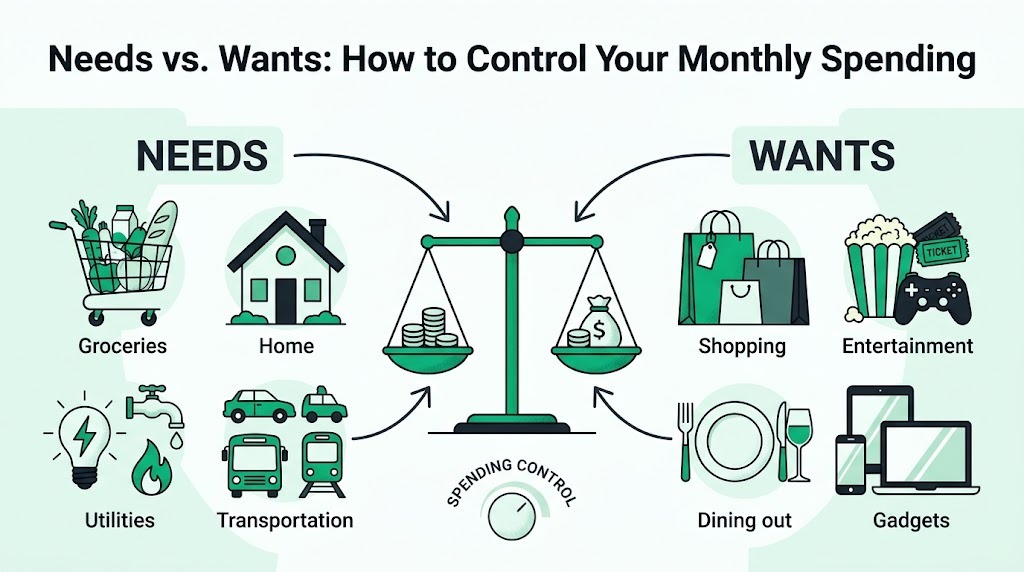
Needs vs. Wants: How to Control Your Monthly Spending
It is easy to spend money on things that feel necessary in the moment. A food delivery order after a long day, a new phone, a sale item, or a paid subscription can all seem reasonable until your bank balance starts dropping faster than expected.
Learning the difference between needs and wants can help you make better spending decisions without removing every enjoyable part of your life. The goal is not to stop buying things you like. The goal is to pay for what matters first and make optional spending fit your income.
Key Takeaways
Needs are essential expenses required for basic living, safety, health, or important responsibilities.
Wants improve comfort or enjoyment but can usually be delayed or reduced.
Some expenses can be needs or wants depending on your situation.
Pay for needs, savings, and minimum debt payments before flexible spending.
Use a waiting period before buying non-essential items.
Set a monthly wants budget instead of trying to eliminate all optional spending.
Ask whether an expense supports your priorities before spending.
Review subscriptions, convenience costs, shopping habits, and food spending.
Use separate categories or accounts to protect money for essential bills.
Update your budget when your income, family, or responsibilities change.
What Is the Difference Between Needs and Wants?
A need is something essential for your basic life, health, safety, work, or important responsibilities. If you do not pay for it, you may face serious problems.
A want is something that makes life more comfortable, convenient, or enjoyable. You may value it, but you can usually delay, reduce, or replace it if your budget is tight.
Examples of Needs
Common needs include:
Housing
Basic groceries
Electricity and water
Essential transportation
Medicines
Healthcare
Minimum debt payments
Basic clothing
Insurance
Phone access for work or safety
Education costs
Childcare
Necessary family support
Examples of Wants
Common wants include:
Restaurant meals
New clothes when you already have enough
Premium subscriptions
Expensive hobbies
Entertainment
Luxury products
Frequent taxi rides
Latest phones and gadgets
Decorative home items
Unplanned travel
Brand-name products when cheaper options work
The difference is not always about the item itself. It often depends on the reason, timing, quantity, and cost.
Why Is It Important to Separate Needs and Wants?
When needs and wants are mixed together, optional spending can take money away from important expenses. You may pay for entertainment while delaying savings, bills, or debt payments.
Separating them helps you:
Protect essential expenses
Reduce impulse purchases
Save more consistently
Control credit card use
Make better shopping decisions
Avoid financial stress
Plan for large purchases
Spend on wants without guilt
This method also gives you more control over your choices. Instead of wondering where your money went, you can see whether your spending matches your priorities.
Needs vs. Wants: A Simple Test
Before buying something, ask yourself these questions:
Do I need this for basic living, health, safety, work, or family responsibility?
What would happen if I did not buy it this week?
Can I delay the purchase?
Do I already own something that serves the same purpose?
Is there a lower-cost alternative?
Did I plan for this expense?
Am I buying it because I need it or because I feel stressed, bored, or pressured?
Will this purchase affect my ability to pay bills or save money?
If the item can wait without causing a serious problem, it is probably a want.
That does not mean you cannot buy it. It means you should place it in your flexible spending plan.
Step 1: List Your Essential Monthly Needs
Start by writing down the expenses you must cover every month.
Your list may include:
Rent or home loan
Electricity and water
Groceries
Basic transport
Medicines
Insurance
School fees
Minimum loan payments
Phone and internet
Childcare
Essential family support
Add the amounts together. This gives you a basic picture of the money required to run your household.
If your income is ₹50,000 and essential needs cost ₹32,000, you have ₹18,000 left for savings, debt repayment, wants, and irregular expenses.
This simple calculation can help you understand how much flexibility you actually have.
Step 2: Separate Fixed Needs From Flexible Needs
Not every need costs the same amount every month.
Fixed Needs
These are expenses that usually remain similar:
Rent
Loan payments
Insurance
School fees
Internet plans
Regular family support
Flexible Needs
These are essential but may change:
Groceries
Electricity
Fuel
Medical expenses
Household supplies
Transport
Flexible needs still require planning. You may need groceries, but the amount you spend can change based on meal planning, prices, waste, and shopping habits.
Step 3: Review Your Wants Without Judgment
Look at your optional spending from the previous month. Do not label yourself as careless or irresponsible.
Instead, identify patterns.
You may notice that you spend more on:
Food delivery after work
Online shopping during sales
Coffee and snacks
Ride-hailing services
Weekend entertainment
Beauty or personal care
Digital subscriptions
Small purchases through social media
The purpose is not to remove everything. It is to see which wants are taking the largest share of your money.
Step 4: Create Three Spending Groups
Some people find it difficult to divide every expense into only two categories. A three-group system can be more practical.
Group One: Must Pay
These are expenses that protect your basic needs and responsibilities.
Examples:
Rent
Groceries
Utilities
Medicines
Minimum loan payments
Essential transport
Group Two: Important but Adjustable
These expenses matter, but you may be able to change the amount.
Examples:
Mobile plans
Internet
Clothing
Household products
Fuel
Family activities
Personal care
Group Three: Optional Spending
These expenses are for comfort, enjoyment, or convenience.
Examples:
Takeaway meals
Entertainment
Shopping
Premium services
Hobbies
Travel
Luxury products
This approach helps you find savings without treating every expense as either completely necessary or completely unnecessary.
Step 5: Use the Delay Test
When you are unsure whether something is a need or a want, ask how long you can delay it.
If you must buy it today to stay safe or meet a basic responsibility, it is likely a need.
If you can wait a week, it may be a want.
If you can wait a month or longer, it is probably optional.
If you forget about it after a few days, you probably did not need it.
This test is especially useful for clothes, electronics, home décor, beauty products, and online purchases.
Step 6: Use the Replacement Test
Ask whether you already own something that does the same job.
Before buying a new jacket, check your wardrobe. Before ordering food, check the kitchen. Before buying another notebook, look through your desk.
A new item may still be useful, but knowing that you already have an alternative can help you make a more careful decision.
Step 7: Use the Cost-per-Use Test
Some wants may be worth buying if you will use them regularly.
For example, a pair of good-quality shoes may cost more than a cheaper pair, but the cost may be reasonable if you use them several times a week for years.
Ask:
How often will I use this?
How long will it last?
Can I maintain it?
Is it replacing something worn out?
Will I still want it after the excitement fades?
Do not use this test to justify every purchase. Use it to compare the long-term value of different options.
Step 8: Set a Wants Budget
Trying to eliminate all wants usually makes budgeting difficult. Instead, create a monthly amount for optional spending.
For example, if your income is ₹50,000, you might set aside:
₹3,000 for eating out
₹2,000 for entertainment
₹2,000 for personal shopping
₹1,000 for hobbies
Your total wants budget would be ₹8,000.
Once the money is used, wait until the next month or move money from another wants category. Avoid taking money from rent, groceries, emergency savings, or debt payments.
Step 9: Choose Your Top Wants
You may not be able to afford every want every month. Choose the ones that give you the most value.
For one person, that may be:
A weekly meal with friends
A hobby
A gym membership
Books
Travel savings
For another person, it may be:
Personal care
Clothing
Entertainment
Coffee
Family activities
There is no universal list of acceptable wants. Your budget should reflect what matters to you, as long as essential expenses and financial goals remain protected.
Step 10: Use a Waiting Period for Larger Purchases
Create a waiting rule for non-essential purchases.
You could use:
24 hours for small purchases
Three days for medium purchases
Seven days for expensive purchases
Thirty days for major lifestyle purchases
During the waiting period, compare prices and check whether the purchase fits your budget.
If you still want the item after the waiting period and have money set aside, you can buy it with more confidence.
Step 11: Remove Emotional Spending Triggers
Many wants become purchases because of emotions rather than actual needs.
You may spend when you feel:
Stressed
Lonely
Bored
Tired
Pressured by others
Disappointed
Celebratory
Insecure
Notice what usually happens before you spend. If you shop after a difficult day, create another response, such as taking a walk, calling a friend, cooking, resting, or writing down your feelings.
You do not need to remove every emotional purchase. Awareness gives you the chance to decide instead of reacting automatically.
Step 12: Control Food Spending
Food is one of the most common areas where needs and wants overlap.
You need food, but you may not need restaurant meals, premium ingredients, delivery fees, or expensive snacks every day.
Try these changes:
Prepare meals at home more often.
Plan meals before grocery shopping.
Keep quick food available for busy days.
Carry water and snacks when leaving home.
Set a weekly eating-out limit.
Use leftovers for lunch.
Check your kitchen before ordering.
Reduce food waste.
You can still enjoy restaurants and delivery. Plan them as wants instead of treating them as automatic needs.
Step 13: Review Convenience Spending
Convenience is useful, but repeated convenience fees can quietly increase monthly spending.
Examples include:
Delivery fees
Express shipping
Taxi rides for short distances
Pre-cut food
Last-minute bookings
Paid upgrades
Ready-made meals
Service charges
Ask whether the convenience saves enough time or effort to justify the price. If it does not, plan ahead and choose the lower-cost option.
Step 14: Separate Basic Clothing From Fashion Shopping
Clothing can be both a need and a want.
Replacing worn-out work clothes or buying clothes for a new job may be necessary. Buying another similar shirt during a sale is usually optional.
Before shopping, check:
What do I already own?
Do I need this for a specific event or responsibility?
Can I wear it in several ways?
Is it comfortable and durable?
Am I buying it because of a discount?
A discount does not create a need.
Step 15: Control Technology Purchases
Phones, laptops, headphones, watches, and other gadgets can be expensive wants.
Before upgrading, ask:
Does my current device work properly?
Is the new feature necessary for work or study?
Can I repair or upgrade my current device?
Can I buy a reliable older model?
Can I save for it without using debt?
If your current device is working, create a technology savings fund instead of using credit for an immediate upgrade.
Step 16: Review Your Subscriptions
Subscriptions often feel small because they are charged automatically. Add them together to see the real monthly cost.
Review:
Streaming services
Music plans
Cloud storage
Fitness memberships
Learning platforms
News services
Gaming subscriptions
App memberships
Cancel services you no longer use. If you use several services occasionally, rotate them instead of paying for all of them at the same time.
Step 17: Protect Money for Bills First
When your income arrives, assign money to essential expenses before spending on wants.
A simple order is:
Housing
Utilities
Food
Transport
Healthcare and insurance
Minimum debt payments
Emergency savings
Other financial goals
Wants
This order helps protect your basic needs and future stability.
Step 18: Use Separate Accounts or Categories
If optional spending often affects your bill money, separate the amounts.
You can use:
One account for bills
One account for everyday spending
One account for savings
Digital envelopes
A spreadsheet
A budgeting app
When your wants money is limited to a separate amount, you are less likely to spend money reserved for essential costs.
Step 19: Plan for Irregular Needs
Some expenses are not monthly but are still important.
Examples include:
Annual insurance
School fees
Vehicle service
Home repairs
Medical checkups
Festival spending
Necessary travel
Professional fees
These may be needs, even if they do not appear on your regular monthly list.
Estimate the yearly cost and divide it by 12. Save that amount each month in a separate sinking fund.
For example, if annual vehicle expenses are around ₹24,000, save ₹2,000 per month.
Step 20: Change Your Budget When Your Life Changes
Your needs can change over time.
A new job may increase transport costs. Moving may change rent and utilities. Marriage, children, health issues, education, or supporting family members can affect your essential expenses.
Review your needs and wants whenever there is a major change in your income or responsibilities.
A budget created two years ago may not match your current life.
Common Mistakes When Managing Needs and Wants
Treating Every Want as a Need
Words such as “I deserve this” or “everyone has one” can make optional spending feel essential. Pause and ask whether the purchase protects your health, safety, income, or basic responsibilities.
Cutting Needs Too Aggressively
Do not reduce important food, healthcare, insurance, or safety expenses just to meet an unrealistic savings target.
Find waste and low-value spending first.
Removing All Fun
A budget without any enjoyment can feel impossible to maintain. Include a reasonable wants category and spend that money without guilt.
Using Debt for Wants
Borrowing for a non-essential item can make a temporary desire create months of payments and interest.
Save first when possible.
Ignoring Small Purchases
A single snack or app payment may not matter. Repeated small expenses can become a large monthly total.
Track patterns rather than focusing only on individual purchases.
Confusing Convenience With Necessity
A taxi may be necessary when you are unsafe or late for work. It may be a want when you are traveling a short distance with plenty of time.
Look at the situation before deciding.
A Simple Monthly Needs and Wants Example
Suppose your take-home income is ₹60,000.
Needs
Rent: ₹18,000
Groceries: ₹8,000
Utilities: ₹3,500
Transport: ₹4,000
Healthcare: ₹2,000
Phone and internet: ₹1,500
Minimum debt payments: ₹4,000
Total needs: ₹41,000
Financial Goals
Emergency fund: ₹4,000
Long-term savings: ₹3,000
Total financial goals: ₹7,000
Wants
Eating out: ₹3,000
Entertainment: ₹1,500
Shopping: ₹2,000
Hobbies: ₹1,000
Total wants: ₹7,500
Flexible Reserve
Unexpected or irregular expenses: ₹4,500
Total planned money: ₹60,000
This plan does not remove wants. It gives them a limit so they do not interfere with essential costs and savings.
A Quick Needs vs. Wants Worksheet
Use these questions when creating your monthly spending plan.
My Monthly Income
Take-home income: ₹__________
My Essential Needs
Housing: ₹__________
Food: ₹__________
Utilities: ₹__________
Transport: ₹__________
Healthcare: ₹__________
Insurance: ₹__________
Debt payments: ₹__________
Other responsibilities: ₹__________
Total needs: ₹__________
My Financial Goals
Emergency fund: ₹__________
Debt repayment: ₹__________
Long-term savings: ₹__________
Future expenses: ₹__________
Total financial goals: ₹__________
My Wants
Eating out: ₹__________
Entertainment: ₹__________
Shopping: ₹__________
Hobbies: ₹__________
Personal care: ₹__________
Total wants: ₹__________
If your planned spending is higher than your income, reduce wants first. If you still have a gap, review flexible needs and look for ways to increase income.
How to Control Your Monthly Spending Without Feeling Restricted
Start with one week of awareness. Track what you spend without changing your habits.
During the second week, choose one category to reduce. You might cook one extra meal at home, avoid one shopping trip, or cancel one unused subscription.
During the third week, set a clear wants limit. Keep the amount realistic and decide how you want to use it before spending.
During the fourth week, review your results. Keep the changes that felt useful and adjust the ones that were too strict.
Controlling your monthly spending is not about saying no to everything. It is about making sure your money supports your needs, goals, and chosen lifestyle in the right order.
Frequently Asked Questions
What is the easiest way to tell if something is a need or a want?
Ask whether you can safely and reasonably delay the purchase. If delaying it would create a serious problem with your health, housing, safety, work, or basic responsibilities, it is likely a need.
If you can wait without serious consequences, it is probably a want.
Is a phone a need or a want?
A basic phone may be a need for communication, safety, work, or study. The latest model, premium features, or frequent upgrades are usually wants.
The answer depends on your work, family needs, and current device.
Are groceries a need or a want?
Basic food is a need. Premium ingredients, snacks, imported products, and frequent convenience foods may be wants.
Plan your grocery list around nutritious meals and your actual household needs.
Should I stop buying wants when my budget is tight?
You may need to reduce wants, but you do not have to remove every enjoyable expense. Set a small amount for personal spending and protect money for bills, food, savings, and debt payments first.
A realistic budget is easier to follow than a plan with no flexibility.
How much of my income should go toward wants?
The amount depends on your income, essential expenses, debt, and goals. Some people may use 10% of their income for wants, while others may have more or less available.
Choose a limit that allows you to cover needs and make progress toward savings.
Can a want become a need?
Yes. Circumstances matter. A laptop may be a want for entertainment but a need if you require it for work or education.
Review the purpose and situation instead of judging the product alone.
Should savings be treated as a need?
Savings are not always an immediate need, but they are important for future stability. Treat emergency savings and essential financial goals as a priority in your monthly plan.
Paying yourself first can help protect your future income and reduce the need for debt.
How can I control spending when my friends spend more?
Set a social budget before making plans. Suggest lower-cost activities, meet at home, or explain that you are working toward a financial goal.
You do not need to match another person’s spending to enjoy their company.
What should I cut first when I overspend?
Start with optional expenses that provide the least value, such as unused subscriptions, frequent delivery fees, impulse shopping, and unplanned entertainment.
Protect essential food, healthcare, housing, and safety expenses.
How often should I review my needs and wants?
Review your spending once a week and update your full budget once a month. Do a deeper review after a major change in income, housing, family responsibilities, or health needs.