Introduction:
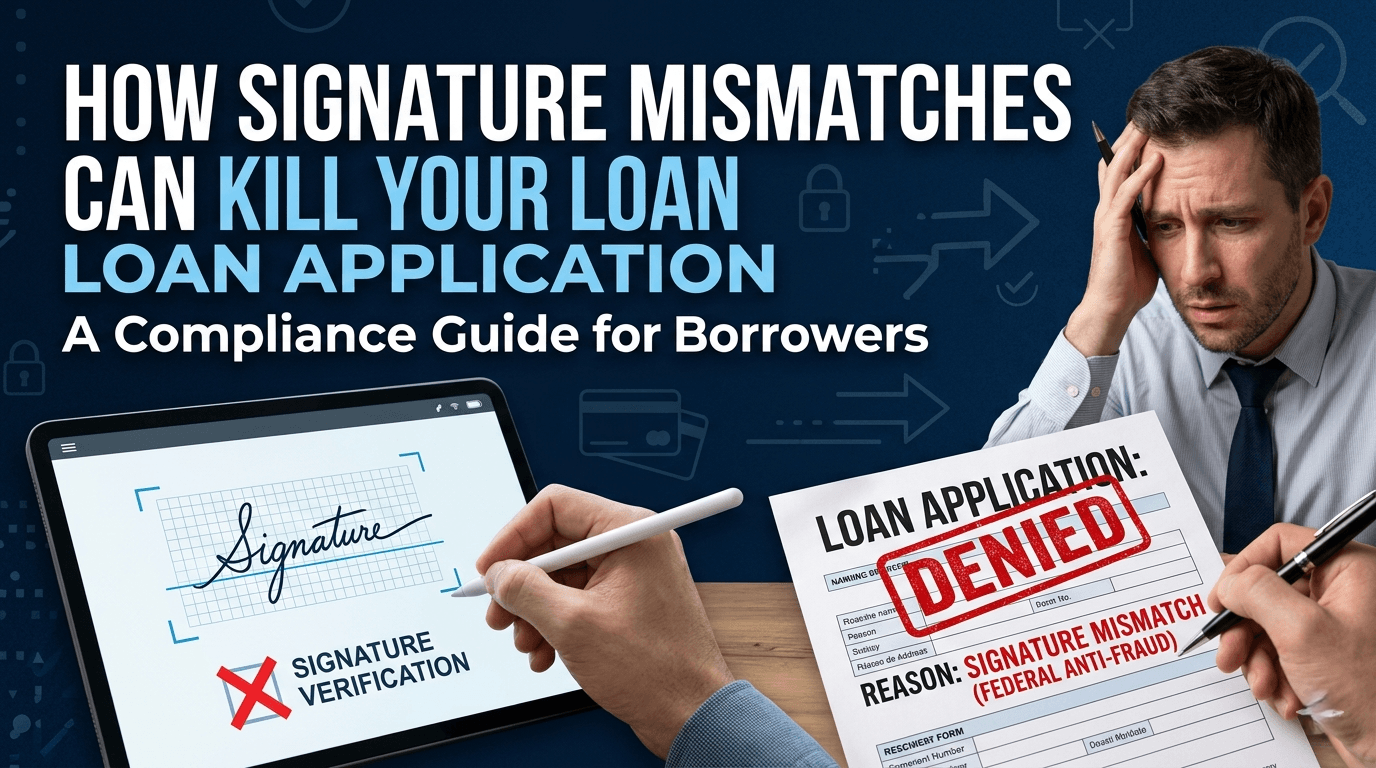
How Signature Mismatches Can Kill Your Loan Application
A Compliance Guide for Borrowers
When you submit a loan application, two separate verification processes happen at the same time. The lender reviews your credit report for payment history and outstanding debt. Separately, automated systems compare your application signature against government-issued identification and banking records.
If either verification fails, the lender must deny your application under federal anti-fraud regulations.
This guide explains what causes signature mismatches, how credit report errors trigger loan denials, and the exact steps you must follow to correct both types of errors. Learn more about avoiding common loan application mistakes here.
What causes a signature mismatch on my loan application?
A signature mismatch occurs when the signature you provide on a loan application does not match the signature the lender has on file from a verified source.
These sources include:
- Your government-issued identification (driver’s license, passport)
- Previous loan documents you signed
- Bank account signature cards
- Credit bureau records
Why this matters: Under federal Know Your Customer rules, banks must verify your identity before approving any loan. A mismatched signature means failed verification. The lender cannot approve your application.
Three common causes of signature mismatch
Cause 1 – Legal name changes without file updates
When you marry, divorce, or legally change your name, you must update your name with the Social Security Administration. However, credit bureaus do not automatically receive this update. If your loan application uses your new legal name but your credit file still contains your previous name, the system flags a mismatch.
Cause 2 – Typographical and spelling variations
Your credit file might list “Robert Johnson” while your driver’s license shows “Robert J. Johnson” or “Rob Johnson.” Automated verification systems treat these as different identities. The system compares character by character. It does not infer or assume.
Cause 3 – Electronic signature capture differences
When you sign electronically using a mouse, touchscreen, or stylus, the system captures the shape, speed, and pressure of your signature. If you signed a previous loan document with a different device or under different conditions, the algorithmic comparison may register a mismatch.
Real-world example: A borrower with a 780 credit score applied for a mortgage. Her driver’s license showed “Katherine M. Chen.” Her credit report showed “Kathy Chen.” The automated system flagged a mismatch. The loan was denied within 24 hours. She corrected her credit file name and was approved 18 days later.
Our Latest Post : 5 Reasons Personal Loans Get Rejected (And How to Fix It)
Our Latest Post : Personal Loan Mistakes, Charges, Approval & Rejection: A Compliance Guide for Borrowers
What credit report errors cause loan denials?
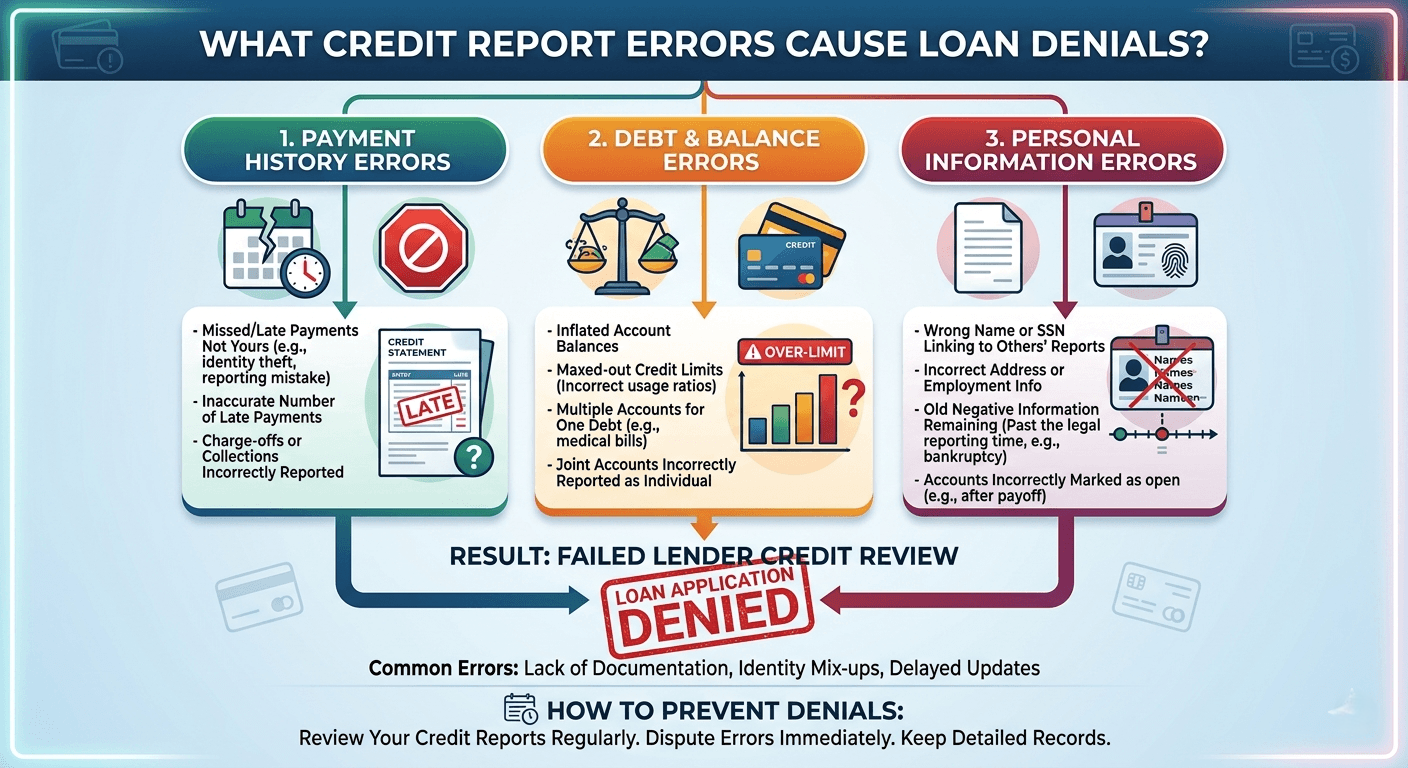
Financial errors vs. identity errors
Credit report errors fall into two categories:
The FTC statistic you must know
According to the Federal Trade Commission, one in five Americans (20%) has a material error on at least one credit report.
Among those, approximately 5% have identity-related errors that could cause a signature mismatch denial. This means approximately 10 million American adults have an error serious enough to affect loan approval.
How mixed credit files destroy loan applications
A mixed credit file occurs when a credit bureau combines your information with another person’s information. This happens most often with:
- Common names (John Smith, Maria Garcia)
- Similar Social Security numbers
- Family members with the same name suffix (Jr. and Sr.)
Consequences of a mixed file:
- Someone else’s late payments appear on your report
- Someone else’s bankruptcy appears on your report
- Someone else’s address appears on your report, creating a signature mismatch
- You cannot simply “delete” the wrong accounts
What you must do instead: Demand file separation under FCRA § 611. This triggers a specialized investigation process.
Real-world example: A customer named “James R. Wilson Jr.” discovered his credit report contained a bankruptcy filed by “James Wilson Sr.” in another state. The bureau had merged father and son records. The son’s loan application was denied despite his own perfect payment history. He filed a written dispute demanding file separation. The correction took 34 days.
The 30-day investigation rule
Under the Fair Credit Reporting Act (FCRA) Section 611, credit bureaus have exactly 30 days to investigate your dispute.
The clock starts when the bureau receives your written dispute. If the bureau fails to complete the investigation within 30 days, it violates federal law. You may sue for statutory damages up to $1,000 plus actual damages, emotional distress damages, and attorney’s fees.
Why do signature mismatch and credit errors happen together?
The common root cause – clerical data entry
A single clerical error can create both a signature mismatch and a credit report error.
Consider this scenario: A bank loan officer types “Rob Johnson” into the credit reporting system. Your legal name is “Robert Johnson Jr.” The credit bureau creates a file for “Rob Johnson.” Later, you apply for a loan as “Robert Johnson Jr.” The verification system finds no match. Simultaneously, the “Rob Johnson” file may contain incorrect information from other consumers named Rob Johnson.
The lender reporting cycle problem
Lenders submit data to credit bureaus every 30 to 45 days.
If you correct your name with a lender today, the credit bureau may not receive the update for up to six weeks. During that gap, any loan application will show a mismatch.
What you can do about the reporting lag
You cannot speed up the lender’s reporting cycle. But you can ask the lender for a letter of correction on their letterhead. Some lenders will provide this document. You can then submit this letter directly to the credit bureau to request an expedited update.
Real case study
A borrower named “Michael Thomas Allen III” applied for a car loan.
His credit report listed:
- “Michael T. Allen” (missing suffix and full middle name)
- An address from five years ago
His driver’s license showed:
- “Michael Thomas Allen III”
- His current address
The automated system flagged:
- Name mismatch (missing suffix “III” and middle name)
- Address mismatch (old address on credit file)
Result: The loan was denied despite a 740 credit score and no late payments.
Fix: The borrower filed written disputes with all three bureaus, attaching his driver’s license, Social Security card, and birth certificate. The corrections took 22 days. He reapplied and was approved.
How do I fix a signature mismatch step by step?
Step 1 – Pull all three credit reports
Go to AnnualCreditReport.com. This is the federally mandated website.
As of 2024, you can pull free weekly reports from Equifax, Experian, and TransUnion. Download each report as a PDF.
Important: Do not use third-party “free credit score” websites. They do not provide complete report data.
Step 2 – Compare personal information line by line
Create a comparison table. For each credit report, check every field.
Any difference between your ID and any credit report constitutes an error that must be disputed.
Step 3 – Mail your dispute letter by certified mail
Do not use online dispute portals. Online portals may require you to waive your right to sue.
What to include in your letter:
- Your full name, including middle initial and suffix
- Your current address and addresses from the past two years
- Each error you want corrected, listed separately
- The reason each item is inaccurate
- Copies (not originals) of your driver’s license, Social Security card, and a utility bill
Sample dispute statement:
“Under FCRA § 611, I request an investigation of the following inaccurate personal information.”
Where to mail:
Atlanta, GA 30374-0256
Allen, TX 75013
Chester, PA 19016
Send your letter by certified mail with return receipt requested. Keep all receipts and copies for your records.
Step 4 – Contact the data furnisher directly
The data furnisher is the bank, credit card company, or lender that originally reported the incorrect information.
Under FCRA § 623, furnishers must investigate and correct inaccurate information. Send a separate dispute letter to each furnisher, also via certified mail.
Step 5 – For mixed files, demand file separation
If a credit report contains accounts or addresses that belong to a different person, write:
“My credit file has been mixed with another consumer’s file. Under FCRA § 611, I demand that you separate these files and delete all information not belonging to me.”
Attach a copy of your government ID. This triggers a specialized investigation process.
What if I need a loan urgently?
The problem – 30 days is too long
A standard FCRA dispute takes 30 days. If you are in the middle of a mortgage closing or need a car loan within two weeks, you cannot wait 30 days.
Rapid rescoring – the 72-hour solution
Rapid rescoring is a paid service (typically $50–$150 per account) that credit bureaus offer to lenders, not directly to consumers.
How it works: Your lender requests rapid rescoring on your behalf. If you have documentation proving an error, your lender can submit correction requests that the bureau processes within 72 hours.
Requirements:
- You must already have a loan application in process with a lender
- The lender must agree to request rapid rescoring (not all lenders offer this)
- You must provide documented proof of the correct information
Direct lender override – the manual review request
Some lenders, particularly credit unions and community banks, have manual underwriting departments.
After you provide proof of corrected records, the underwriter may override the automated denial. This is not guaranteed, but it is worth requesting in writing.
Real-world example: A home buyer was scheduled to close in 10 days. His credit report incorrectly showed a $5,000 balance on a credit card he had paid off. The bank refused to close with the error. He provided the paid-in-full letter. The lender requested rapid rescoring. The bureau updated the report in 48 hours. The closing happened on schedule.
What are my legal rights under FCRA?
The $1,000 statutory damages provision
Under FCRA § 616, any credit bureau or furnisher that willfully fails to comply with the FCRA is liable for:
- Actual damages (what you lost financially), or
- Statutory damages of $1,000, whichever is greater
What counts as “willful failure”:
- Rubber-stamping “verified” responses without a reasonable investigation
- Ignoring your dispute entirely
- Failing to respond within 30 days
Attorney’s fees and court costs
FCRA § 616 also requires losing defendants to pay your reasonable attorney’s fees and court costs.
This means consumer protection attorneys often take FCRA cases on contingency. You pay nothing unless you win.
Filing a CFPB complaint
Before suing, file a complaint with the Consumer Financial Protection Bureau at consumerfinance.gov/complaint.
The CFPB has increased enforcement against credit bureaus for inadequate investigations. A CFPB complaint often resolves disputes faster than litigation.
Comparison table – Errors and required actions
| Type of Error | Examples | Required Action | Typical Resolution Time |
|---|---|---|---|
| Name spelling mismatch | “Jon” vs. “Jonathan” | Written dispute with ID attached | 30 days |
| Name suffix missing | “Robert Smith Jr.” vs. “Robert Smith” | Written dispute with birth certificate | 30 days |
| Wrong address | Old address on file | Dispute + update with each furnisher | 30 days |
| Mixed credit file | Someone else’s accounts on your report | Demand file separation (FCRA § 611) | 30–45 days |
| Signature mismatch | Mismatched application signature | Update name with furnisher + rapid rescoring | 72 hours |
| Wrong SSN | Transposed digits | Written dispute with Social Security card | 30 days |
Frequently Asked Questions
1. Can a signature mismatch affect my credit score?
No. Signature mismatch affects loan approval, not your credit score.
2. How do I know if my credit file has a mixed file error?
Pull all three credit reports. If you see accounts, addresses, or names you do not recognize, your file may be mixed.
3. What documents prove my correct signature to a credit bureau?
Send copies of your government-issued photo ID, Social Security card, birth certificate, and a recent utility bill. Do not send originals.
4. How long does rapid rescoring take?
72 hours from when the bureau receives the corrected data from your lender.
5. Can I sue a credit bureau for refusing to fix an error?
Yes. Under FCRA § 616, you may sue for $1,000 plus actual damages and attorney’s fees.
6. Will every lender deny my loan for a signature mismatch?
Automated online lenders will deny immediately. A credit union or community bank may work with you if you provide proof of corrected records.
7. What is the difference between a signature mismatch and identity theft?
Signature mismatch is a clerical error. Identity theft means someone else is using your identity fraudulently.
8. Do I need a lawyer to fix a signature mismatch?
No. You can file disputes yourself using certified mail. If the bureau refuses to correct after 30 days, consult a lawyer.
9. What should I do if the credit bureau says my dispute is “frivolous”?
Write back demanding a specific explanation. File a CFPB complaint immediately.
10. Can I add a statement of dispute to my credit file?
Yes. Under FCRA § 611(b), you can request that your 100-word statement be included in future credit reports.
11. How long does an error stay on my credit report after I dispute it?
If the bureau finds the information inaccurate, it must delete or correct it within 30 days.
12. What if the lender pulls my credit report before my dispute is finished?
You can add a “consumer statement” stating that information is in dispute. Some lenders will delay decisions until the dispute is resolved.
Conclusion
Before you submit any loan application, pull your credit reports from all three bureaus. Compare every piece of personal information against your government ID. Dispute any discrepancy via certified mail, not online portals.
If your loan deadline is urgent, ask your lender about rapid rescoring.
Do not assume that a high credit score protects you from a signature mismatch denial. The automated verification system checks your identity first.
Fix your records first. Then apply for the loan.