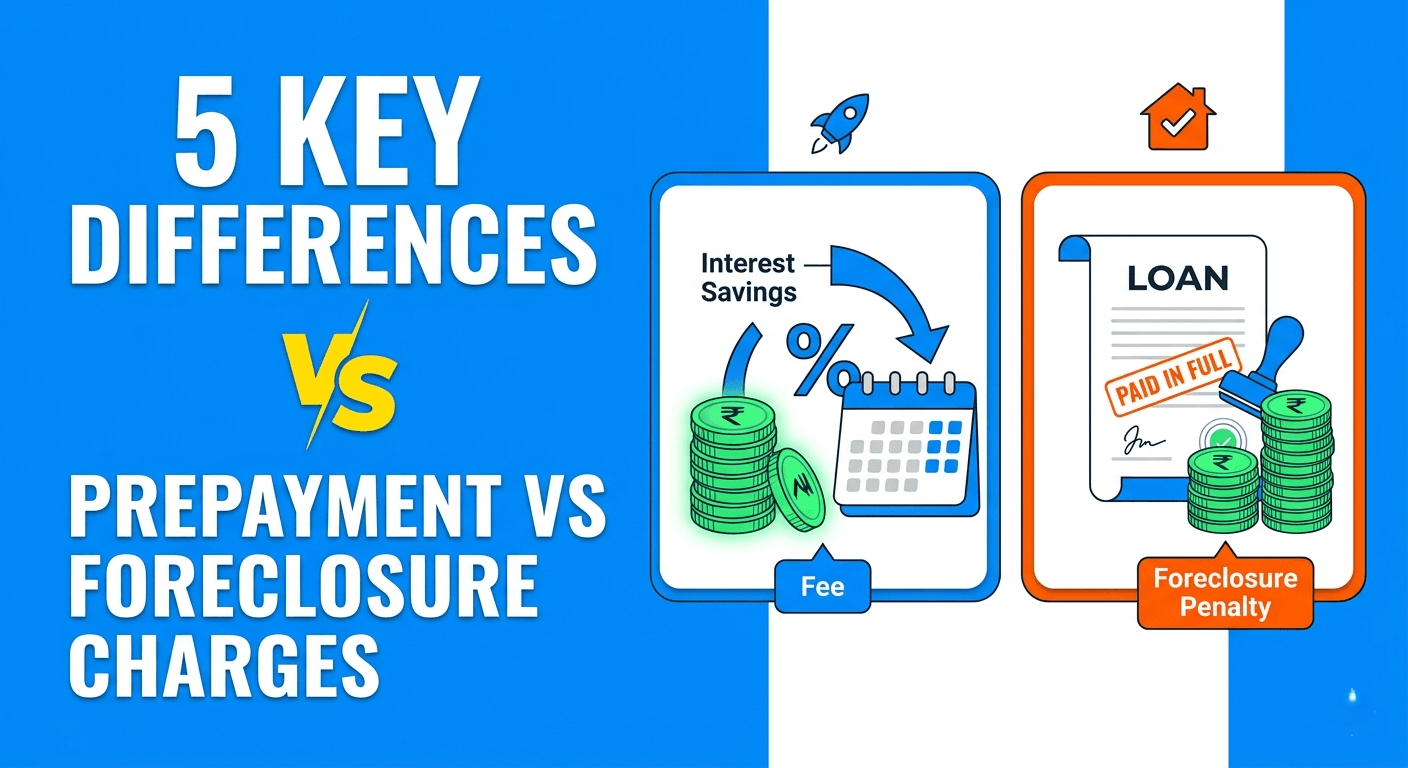
Quick Answer: Should you prepay or foreclose?
Deciding whether to clear your debt early depends on your extra cash and interest savings. Here are 5 Key Differences: Prepayment vs Foreclosure Charges to help you decide:
- Prepay (Partial Payment): Choose this if you have extra cash but cannot settle the full loan amount. It effectively reduces your principal and, consequently, your future interest burden.
- Foreclose (Full Payment): Choose this only if you have enough cash to pay the entire remaining balance AND the savings on remaining interest significantly outweigh the foreclosure penalty.
Section 1: What Are Prepayment and Foreclosure?
Prepayment – Partial Payment
You pay a lump sum toward your loan balance. Your loan stays active.
Example: Loan = ₹5,00,000. Prepayment = ₹1,00,000. New balance = ₹4,00,000.
Two outcomes possible after prepayment:
- Your EMI goes down (lower monthly payment)
- Your loan ends sooner (same EMI, fewer months)
You can choose. Most banks offer both options.
Foreclosure – Full Payment
You pay the entire remaining loan balance. Your loan closes permanently.
Example: Outstanding balance = ₹3,60,000. You pay ₹3,60,000 plus foreclosure charges. Bank gives you a No Objection Certificate (NOC). Loan is closed.
The Key Difference
| Feature | Prepayment | Foreclosure |
|---|---|---|
| Amount you pay | Part of the balance | Entire balance |
| Loan after payment | Still active | Closed |
| Charge applies to | The amount you prepay | The entire outstanding balance |
Section 2: Prepayment Charges – How They Work
The Charge Formula
Prepayment charge = (Prepaid amount) × (Bank’s percentage) + 18% GST on the fee
Example: You prepay ₹1,00,000. Bank charges 4%.
- Fee = ₹1,00,000 × 4% = ₹4,000
- GST = ₹4,000 × 18% = ₹720
- Total you pay extra = ₹4,720
Lock-in Period
Most banks do NOT allow any prepayment for the first 6 to 12 months.
- SBI: No prepayment for first 12 months
- HDFC Bank: No prepayment for first 13 months
- ICICI Bank: No prepayment for first 12 months
After the lock-in period ends, prepayment is allowed.
Bank-by-Bank Prepayment Charges (Fixed-Rate Loans)
| Bank | Lock-in Period | Prepayment Charge |
|---|---|---|
| SBI | 12+ months | 3% of prepaid amount + GST |
| HDFC Bank | 13–24 months | 4% + GST |
| HDFC Bank | 25–36 months | 3% + GST |
| HDFC Bank | 36+ months | 2% + GST |
| ICICI Bank | 12+ months | 5% + GST |
| Poonawalla Fincorp | After 6 EMIs | 0% (if using own funds) |
Frequency Limits
Some banks limit how often you can prepay.
- HDFC Bank: Maximum 2 prepayments per financial year
- Some lenders: Maximum 25% of original loan amount per year
Check your loan agreement before prepaying.
Section 3: Foreclosure Charges – How They Work
The Charge Formula
Foreclosure charge = (Outstanding balance) × (Bank’s percentage) + 18% GST on the fee
Example: Outstanding balance = ₹3,60,000. Bank charges 5%.
- Fee = ₹3,60,000 × 5% = ₹18,000
- GST = ₹18,000 × 18% = ₹3,240
- Total extra payment = ₹21,240
Bank-by-Bank Foreclosure Charges
| Lender | Lock-in Period | Foreclosure Charge |
|---|---|---|
| SBI | 12+ months | 3% of outstanding + GST |
| HDFC Bank | 12+ months | 4% (reduces to 2% after 36 months) + GST |
| Bajaj Finance | 12+ months | Up to 5% + GST |
| Tata Capital | 6+ months | 0% (check current offer) |
| Bank of India | 12+ months | 0.65% per year of remaining tenure (max 2.25% total) |
The GST Trap
Many borrowers think GST applies to the entire foreclosure payment. This is wrong.
Correct calculation:
- Principal repayment: ₹3,60,000 (0% GST)
- Foreclosure fee: ₹18,000 (18% GST = ₹3,240)
- Total payment: ₹3,81,240
Incorrect calculation (watch for this):
- Bank adds GST to ₹3,78,000 instead of ₹18,000
Always ask for an itemized statement.
Zero Foreclosure Charge Cases
- Floating-rate personal loans sanctioned after January 1, 2026 (new RBI rule)
- Some lenders after 24-36 months (Tata Capital, Poonawalla Fincorp)
- If you use your own money (not a balance transfer from another lender)
Section 4: RBI Guidelines – Important Update for 2026
What Changed?
On July 2, 2025, RBI issued the “Pre-payment Charges on Loans Directions, 2025.” Effective January 1, 2026.
For floating-rate personal loans sanctioned or renewed on or after January 1, 2026:
- Zero prepayment charges
- Zero foreclosure charges
- No lock-in period
For fixed-rate personal loans:
- Charges still allowed
- Must be disclosed in your sanction letter
- Lock-in period permitted (up to 12 months)
Does This Apply to Your Loan?
| Loan Type | Sanction Date | Charges Apply? |
|---|---|---|
| Floating Rate | On or after Jan 1, 2026 | NO charges |
| Floating Rate | Before Jan 1, 2026 | Check your agreement |
| Fixed Rate | Any date | YES, charges apply |
Can You Convert to Floating Rate?
Yes. Request your lender to convert your fixed-rate loan to floating rate. If approved, your loan is considered “renewed.” The zero-charge rule applies after conversion.
Submit your conversion request before December 1, 2025 to ensure processing before the January 1, 2026 deadline.
Section 5: Real Examples – Which Saves More Money?
Example 1: Prepayment (Partial Payment)
Borrower: Ms. Mehta
Loan: ₹5,00,000 at 14% for 36 months
EMI: ₹17,100
After 12 months:
- Outstanding balance = ₹3,60,000
- She prepays ₹1,00,000
Cost:
- Prepayment charge (4%) = ₹4,000 + 18% GST (₹720) = ₹4,720
- She pays ₹1,04,720 total
Benefit:
- New balance = ₹2,60,000
- Remaining interest saved = ₹30,000
- Net benefit = ₹30,000 – ₹4,720 = ₹25,280
Example 2: Foreclosure (Full Payment)
Same loan details as above
After 12 months:
- Outstanding balance = ₹3,60,000
- She pays the full balance
Cost:
- Foreclosure charge (5%) = ₹18,000 + 18% GST (₹3,240) = ₹21,240
- She pays ₹3,81,240 total
Benefit:
- Interest already paid (first 12 months) = ₹40,000
- Original total interest = ₹1,15,600
- Interest saved = ₹1,15,600 – ₹40,000 = ₹75,600
- Net benefit = ₹75,600 – ₹21,240 = ₹54,360
Conclusion: Foreclosure saved ₹54,360. Prepayment saved ₹25,280. But foreclosure required ₹3,60,000 cash. Prepayment required only ₹1,04,720.
Example 3: When NOT to Foreclose
Borrower: Mr. Nair
Loan: ₹1,80,000 remaining, 8 months left
Remaining interest payable: ₹11,000
Foreclosure charge: 5% of ₹1,80,000 = ₹9,000 + 18% GST = ₹10,620
Comparison:
- Interest saved by foreclosing = ₹11,000
- Cost of foreclosure = ₹10,620
- Net benefit = only ₹380
Outcome: Mr. Nair continued paying EMIs. The small savings were not worth the effort.
Section 6: Hidden Charges Banks Often Don’t Explain
GST on Service Fee
GST applies only to the prepayment or foreclosure fee. Not to the principal. Some banks miscalculate this. Check your statement.
Document Retrieval and NOC Charges
After foreclosure, banks may charge ₹500 to ₹1,000 for issuing the No Objection Certificate. This is separate from foreclosure charges.
Stamp Duty by State
- Maharashtra: ₹500
- Karnataka: ₹200
- West Bengal: ₹100
- Delhi: ₹0 (no stamp duty)
Penalty for Extra Prepayments
If your bank allows only 2 prepayments per year and you make a third, the bank may reject it or charge a fee.
Section 7: How Foreclosure Affects Your CIBIL Score
Prepayment – Positive or Neutral
Your credit utilization goes down (you owe less). This usually helps your CIBIL score. The loan stays active, which credit agencies like to see.
Foreclosure – Temporary Drop Possible
When you close a loan, your credit report marks it “closed.”
If this was your only active unsecured loan:
- Your CIBIL score may drop 20 to 50 points
- The drop lasts 1 to 3 months
- The score recovers on its own
Important for home loan applicants: Do NOT foreclose your personal loan less than 3 months before applying for a home loan. The temporary score drop may affect your interest rate.
Section 8: Expert Insights
CA Ramesh Kothari, Mumbai-based financial advisor (14 years experience):
“I have reviewed over 500 personal loan prepayment cases. In 80% of cases where borrowers chose ‘reduce EMI’ instead of ‘reduce tenure,’ they paid at least 40% more total interest than necessary. Banks do not explain this difference during the prepayment process. Always choose ‘reduce tenure’ unless you genuinely cannot afford your current EMI.”
Ms. Priya Srinivasan, former RBI banking regulation officer (2010–2022):
“The RBI Directions 2025 close a long-standing regulatory gap. Before this, only home loans had zero foreclosure charges for floating-rate borrowers. Now all floating-rate personal loans are covered. However, borrowers must understand this applies only to floating-rate loans. Fixed-rate personal loans remain chargeable. Check your sanction letter immediately.”
Section 9: Frequently Asked Questions (12 Questions)
1. Is prepayment better than foreclosure?
Prepayment is better when you have partial cash but cannot close the full loan. Foreclosure is better when you have full cash AND the remaining interest is higher than the foreclosure charge.
2. Do all banks charge foreclosure fees?
Most do for fixed-rate loans. Starting January 1, 2026, floating-rate loans from all regulated lenders will have zero charges.
3. Can I foreclose within 1 month of taking the loan?
Generally no. Most lenders have a 6 to 12 month lock-in period. No prepayment or foreclosure is allowed during this time.
4. Are prepayment charges legal?
Yes, for fixed-rate personal loans. No, for floating-rate personal loans sanctioned after January 1, 2026.
5. Does prepayment reduce EMI or tenure?
Most banks let you choose. To save the most interest, choose “reduce tenure.” To lower your monthly payment, choose “reduce EMI.”
6. How is GST calculated on foreclosure charges?
Correct: Foreclosure fee × 18% = GST. Incorrect: (Foreclosure fee + principal) × 18%. Always ask for an itemized statement.
7. Can I negotiate foreclosure charges?
Yes. If you have a good repayment history (no late payments), write to your branch manager requesting a reduction or waiver.
8. What documents must the bank give after foreclosure?
- No Objection Certificate (NOC)
- Loan closure letter
- Original loan documents (if any were submitted)
- Updated credit report confirmation
The NOC is the most important document. Keep it forever.
9. Will my CIBIL score drop after foreclosure?
Temporarily, yes. By 20 to 50 points for 1 to 3 months if you have no other active credit accounts. The score recovers.
10. Does the RBI 2026 rule apply to my existing fixed-rate loan?
No. The rule applies only to floating-rate loans sanctioned or renewed on or after January 1, 2026. Your fixed-rate loan keeps its original charges.
11. Can I prepay or foreclose using a credit card?
File a complaint with the Banking Ombudsman (toll-free 14448). Also escalate to the lender’s grievance officer. Keep proof of your full payment (bank statement, transaction receipt).
12. What if the bank does not give me an NOC after foreclosure?
No. Lenders accept only bank transfers (NEFT/RTGS/IMPS), UPI (for small amounts), demand drafts, or cash at branches. Credit card payments are not allowed.
Conclusion
Your decision checklist:
- Do you have partial extra cash? → Prepay
- Do you have full cash to close the loan? → Compare remaining interest vs foreclosure charge
- Is your loan floating rate and sanctioned after Jan 1, 2026? → Zero charges. Foreclose freely.
- Is your loan fixed rate? → Calculate carefully. Charges apply.
- Are you applying for a home loan soon? → Do not foreclose 3 months before applying.
Read your sanction letter. Know your interest rate type. Calculate before you pay.l